Artificial Intelligence Listens to the Trees

Nejc Trampuž, a young multimedia artist from Slovenia, will host a workshop on creating art with the help of artificial intelligence tools that he has been using in his work for the past year and a half. He will mainly introduce tools that enable generation of animations: the open-source Stable Diffusion (Deforum, ControlNet) in Automatic 1111 WebUI. The workshop will also be a space for sharing knowledge of others among participants and for discussing the society of the future that artificial intelligence brings on one hand, and the ecological threat on the other.

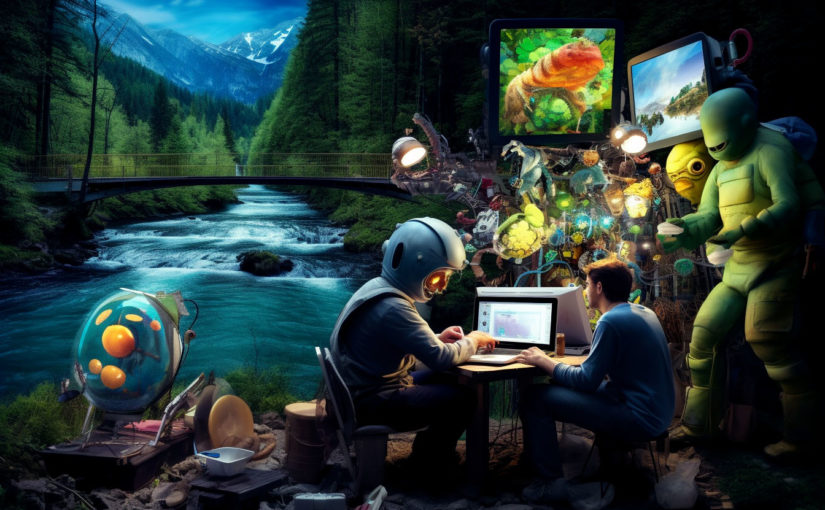
In addition to the workshop his goal is to work on his project with the working title “We Must First Listen to the Trees,” which is being developed under the scholarship from the Slovenian Ministry of Culture. The emerging short experimental generative animated film, created with the assistance of artificial intelligence – both in terms of the screenplay and animation – will reflect society in relation to the environment and ecosystem. It will conceive and present sustainable and environmentally friendly ways of living.

The River Knows by duo Swamp_Matter

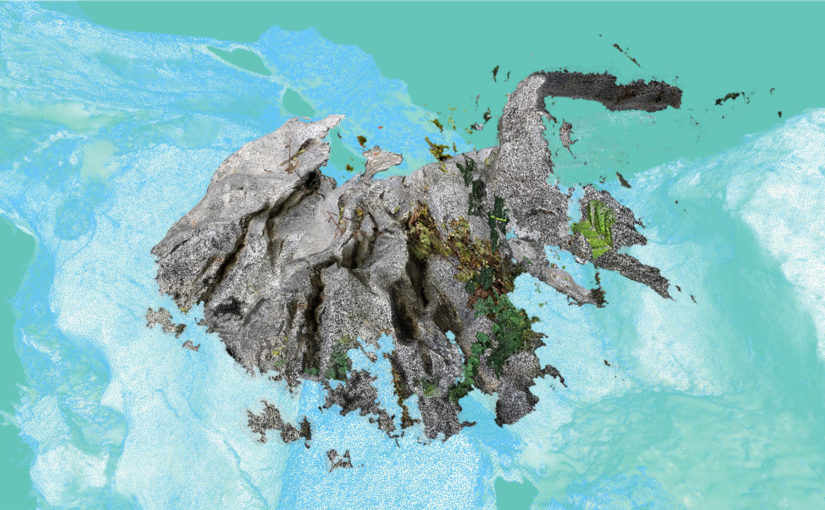
The project aims to engage with water scarcity and real-time visual storytelling to speculate on climate futures of the Soča River in Slovenia. The bed of the glacial river has been shaped by its waters in remarkable geological formations for millennia. Recently the river’s water level has been low due to summer drought, a consequence of anthropogenic factors. The project looks at the interplay and relationship between humans and the river’s geological processes. It reflects on changing ecologies and raises awareness for the conservation of this important water ecology through speculation. The project aims to use 3D scanning and photogrammetry to create a digital extension of the Soča landscape with particular attention to the dry riverbed and glacial rocks. The digital landscape will be linked to sensors placed in the landscape recording various parameters in real-time (landscape sound, water level, pollution, rainfall) which will create distortions and deformations within the digital landscape.

Swamp_Matter is a duo consisting of Eva Garibaldi (designer & researcher) and Ana Laura Richter (artist & dramaturg) motivated by a shared passion for exploring the complexities and mysteries of amphibious landscapes. Their work is driven by a deep curiosity about the relationship between humans and nature, and the ways in which this relationship is constantly evolving. Through their projects, Swamp_Matter seeks to challenge the perception of unstable landscapes as stagnant and lifeless places, and instead, highlight the rich biodiversity and ecological significance of these often-overlooked environments.

Fungi Internet – Mycorrhizal Communication Infrastructure

Wouldn’t it be amazing if we did not have to build a cable network for The Internet but could just dock onto existing naturally grown ones?

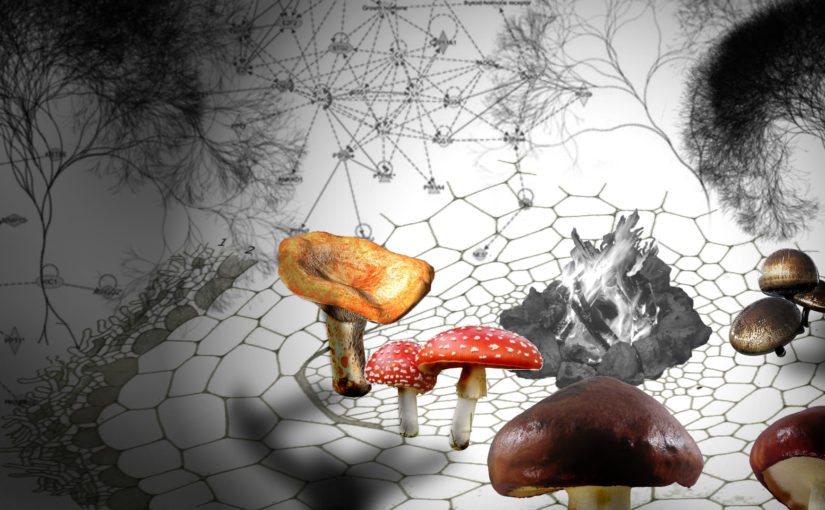
There are dense mycorrhizal (fungi) networks in the forests that live in symbiosis with plants, receiving carbohydrates from photosynthesis and therefor providing the plants with nutrients from the soil.
But more importantly for this project: They provide a nutrient exchange system between the plants and communication channels that function by chemical and electric signalling.

Let´s compare systems on different scales and built on different matter that work with electrical and/or chemical signalling:
The first that come to mind are brains, thunderstorms, electricity networks like computers or world wide communication infrastructure.

While the weather with its electrical charge and discharge as well as brains and mycorrhizal networks exist naturally, we build our digital communication system from glass fibres and cooled server farms.

I want to propose the idea to benefit from and nurture existing fungal systems and try to send messages via these already existing paths, maybe invite the networks to grow close to human communities and create a data highway of nutrients and information.

This is a speculative storytelling project – very welcome to lead to scientific research and connect already existing studies to it, but most importantly I want to spin ideas.

Some questions to start with:

– which communication protocols are used in fungi networks and what is their message transfer speed?
– how does the symbiosis between fungi and plants work, how can it be abused?
– what does the fungal network need to flourish?
– simple (theoretical) experiments of sending a signal through a fungal network
– looking for benefits for the environment and the human need for a functioning communication infrastructure

The first story-telling and speculation session at PIFcamp will be on Monday, August 9th at 6pm.

Fungi Internet is a project by Rosi Grillmair.

Wavey Wind, The Modul-air Mitt

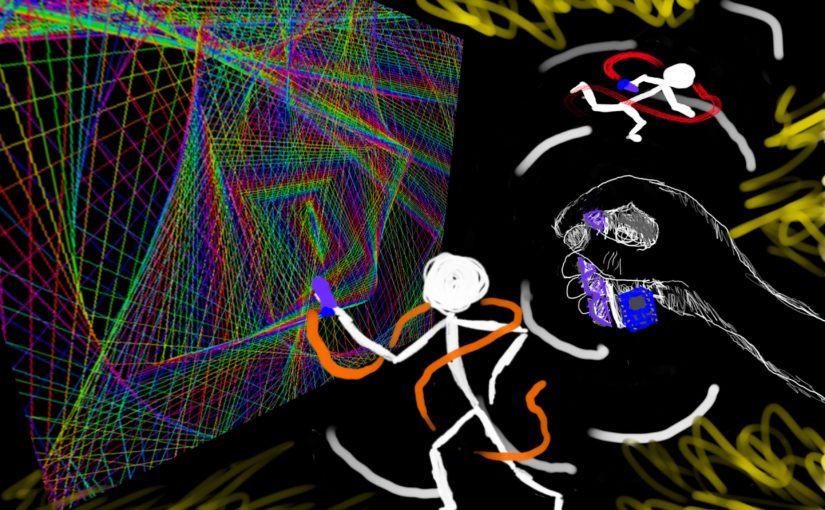
Using an ESP32 microcontroller with wifi and bluetooth capability, a gyroscope/accelerometer module and keyboards switches, Jurij Podgoršek will be building an experimental low cost motion “glove” controller with a button for each finger.

The idea stems from an earlier abstract visualisation project which was intended to visualise music. After building the initial prototype and hooking it up with a touch user interface of sliders that modulate the visuals, the author asked himself – why should I make the program interpret music? We already do that when we listen and (can) react by dancing; using a motion sensor, the dancing can be “amplified” by turning bodily motions into shapes and colours projected on a surface.

Using the motion mitt, the operator of visuals doesn’t have to get locked into a clumsy little touchscreen but can immerse in the experience of sound and video while co-creating it. A workshop will be held to build a number of gloves that can connect in an ad-hoc network, so that group of people could collaborate with them.

The glove(s) will send events via the open sound control protocol, opening the possibility to using using them for audio synthesis/modulation, or maybe even as a general interface.

“What Can a Body Do?”

Open hardware with open software – an introduction into designing PCBs with KiCad

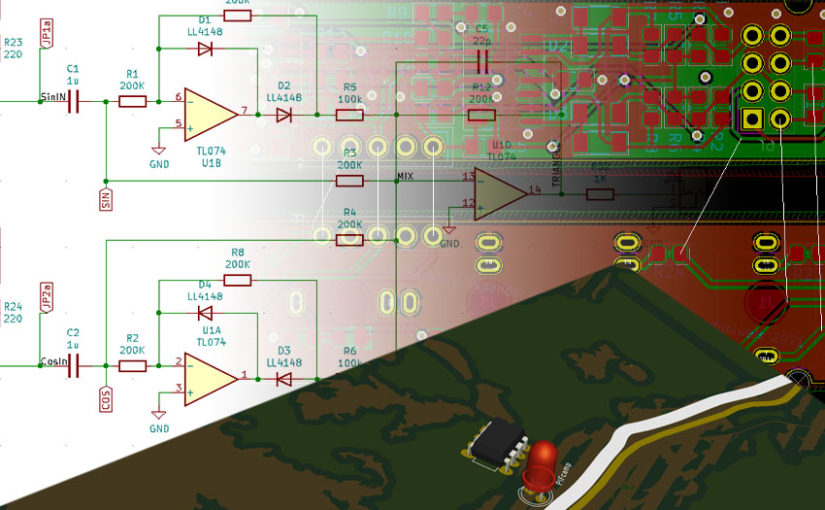
Electronic devices are all around us. Whether it’s your washing machine or the device you’re reading this text on – they all have one thing in common: they contain printed circuit boards. PCBs are usually a tasty sandwich of an insulating material and one or multiple layers of thin copper used to connect electronic components and keep them mechanically fixed.

Whether you want to etch them yourself with some acid in your bathroom or you have them professionally made in a factory – learning how to design them is a super useful skill to have for anybody interested in building electronics (and potentially even for other, more unorthodox uses…).

At this years PIFcamp Klemens Kohlweis will hold a workshop on how to design your own PCBs using the (awesome!) open source software KiCad. Starting early in the week we will talk about challenges and possibilities of the design and manufacturing process, then go on to drawing our own functional and/or beautiful circuit-boards – and hopefully even get them manufactured in the same week!

PIFcamp Community Harvest

During this PIFcamp Community Harvest, media art historian Heather Contant solicits, records, digitizes, collects, and redistributes past and present memories and materials related to PIFcamp: its participants and its organizers Ljudmila, Projekt Atol, and Kersnikova’s Rampa Lab and BioTehna. The aim of this Community Harvest is to simultaneously illuminate the significance, vibrancy, and unique perspectives of the creators, collectives and practices emerging from this region and to keep the community flourishing, by providing virtual and physical forums, in which community members can share their memories and artefacts, reconnect with one another, and discuss their current and future work.

The metaphorical ‘fruit’ of this harvest will be made accessible to all via the PIFcamp website, providing a database for future community members and historians. Heather will also use this material—these signals of the past in the present—to create an improvisational performance, inspired by Signal-Sever!Scatter!, the Wardenclyffe Situations (collective performances by Marko Peljhan and Projekt Atol from the 1990s and 2000s). During this performance, individuals will be free to reconfigure the raw ingredients collected during the harvest to produce a multi-media feast to inspire and hopefully feed the community for future generations. 

IF YOU OR ANY OF YOUR LOVED ONES HAVE MEMORIES OR MATERIALS RELATED TO PIFCAMP OR ITS ORGANIZING BODIES: LJUDMILA, PROJEKT ATOL, OR KERSNIKOVA – RAMPA LAB & BIOTEHNA, WE ARE STANDING BY! CONTACT HEATHER AT this.is.editor@gmail.com TO PARTICIPATE IN HARVEST FESTIVITIES NOW! 

OctoSens

The OctoSens is a community project formed by a group of music and technology enthusiasts who, under the guidance of Vaclav Peloušek (Bastl Instruments), are combining different perspectives while developing an interface that will enable the simultaneous use of different sensors to synthesise sound and control other devices.

OctoSens

Development of a multi-sensorial synthesizer is a part of Projekt Atol and konS platform AIR programme.

Sensors and music

Musicians are always searching for new ways of creating and modifying sound. The development of new technologies and their accessibility have propelled and enabled use of sensors in sound design. However, the great variety of different sensors and lack of practical interfaces often requires a grasp on advanced technological knowledge or compels the artists to buy expensive specialised equipment; both requirements can hinder the creative process.

We decided to find solutions to this problem which would allow artists to use a great number of different sensors in an easy and intuitive way in order to modify sound. Under the guidance of Vaclav Peloušek (Bastl instruments) we have collectively designed a device and named it OctoSens.

What is OctoSens?

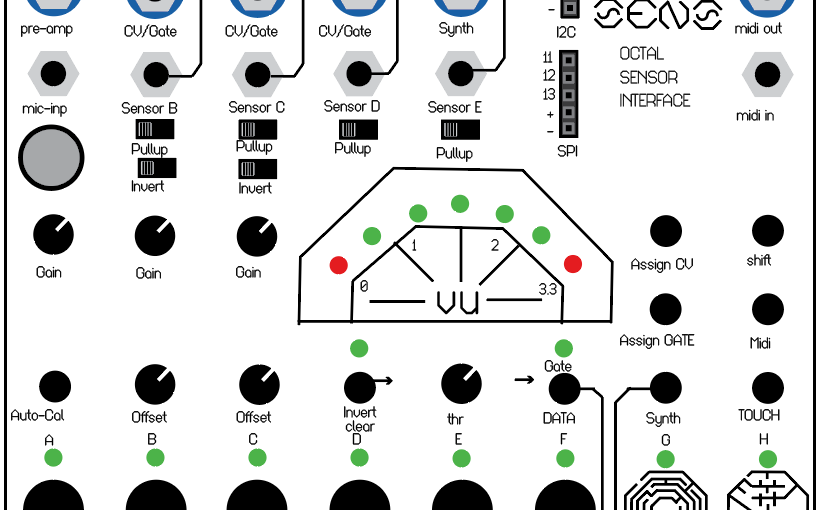
Having 4 analog and two digital inputs for external sensors, as well as two touchpads, the OctoSens offers 8 different ways of altering the desired parameters of sound. A built-in microphone, two tactile sensors and a digital synthesizer integrated in the microcontroller enable us to use OctoSens individually without external sensors and other instruments. We can simply connect the OctoSens to a speaker and start creating. We can use the information detected by the sensors to control volume, pitch, filter frequency and other parameters of the integrated digital synthesizer. Artists who already have other instruments, synthesizers and effects could use the OctoSens to connect to their existing gear and multiply its functionality: OctoSens can output different Cv/gate signals and create MIDI information, which can be used to control multiple external devices simultaneously. OctoSens will conform to Eurorack format so that synth-enthusiasts could incorporate it into their Eurorack setup, however, an individual enclosure for those who prefer to use it as a stand-alone device, will be available as well. It will be compatible with the popular microcontrollers Arduino micro and Teensy 3.2 which means that it will be accessible to a wide circle of DIY enthusiasts to further increase its functionality with their own code.

Practical example of the use of OctoSens

So, would you like to adjust the tempo of the song to fit your heartbeat, adapt the volume according to light and control the pitch with the movement of your body? All you have to do, is connect a heart-beat sensor and a light sensor to the analog inputs of the OctoSens and a gyroscope to one of the digital inputs. By pressing the multifunction buttons, we can map the connected sensors to the desired parameters of the integrated synth and use the rotary knobs to calibrate the sensors to a level, ideal for modulating the sound in a musical way.

The objective of the OctoSens project

OctoSens will be an innovative and a competitive product on the quickly evolving market of electronic instruments. At the same time, it will exist in the form of a DIY workshop that will enable its participants to learn exactly how the sensors work and become more knowledgeable on sound synthesis as well as the basics of electronics.

The goal of this project is not solely the process of product development and sale, but it is foremost an effort of creating a community that brings together different generations, providing an interdisciplinary environment that offers an invaluable exchange of knowledge between professional engineers, artists, students of different fields and audio-electronics enthusiasts.
Mechanical Nature

Anna Carreras, Marta Verde and Mónica Rikić want to develop an artistic intervention or interactive device, mixing code, electronics, visuals and nature. In their own separate artistic practice they mainly work with randomness, complexity and robotics. They are planning on putting all their expertise together and have fun creating a new artistic collaboration from scratch on site.

Conceptually, their proposal seeks the nature of machines from speculative fiction. Through the prototyping of autonomous micro systems, they want to talk about the freedom of machines and the search for their own essence far from human projection, technological development and its obsession on imposing an artificial intelligence to it, understanding AI as the search of an improved human copy.

To search for this “Mechanical Nature”, they want to use their personal research on different non-human complex systems: how they are generated, organised, regulated, and hierarchised. Also, experiment with the different possibilities of the simple movements of the micro robots made by motors and other small electronic components, individually and as a group. They will try to create behaviour patterns for these self-sufficient mechanical organisms inspired by insects, plants, wind, clouds, water, any non-human data we can get inspired from, and let them flow. They also intend to use different materials found in nature to combine them with the small electronic components and microcontrollers and generate these ecosystems.

The process of creating them would be as follows:
– Selection and observation of a specific aspect of nature
– Experimentation of the patterns regarding the mechanical application of them
– Experimentation with natural materials in conjunction with technological ones
– Flow of matter and energy within the ecosystem: how some beings depend on each other within that world, how they relate and communicate with each other and with the environment.

The elements and materials they will use to create ecosystems will be: low voltage micro motors, small sensors and actuators (such as LEDs, mp3 players, photoresistors, electromagnets), organic materials (like woods, leaves, moss, stones, water – in different forms- , flowers, seeds).