Serial Drama Lab

Serial Drama Lab by Sabina Suru operates at a crossover between a collective therapy session and a qualitative research focus group. It is designed to map the psychological and artistic coping mechanisms we deploy when confronted with technological failure. Rather than treating technical breakdowns as mere engineering bugs to be resolved, this lab investigates the feraldynamics of technology—the moments when hardware, code, or chemical mediums slip from our control and exhibit an autonomous, unpredictable agency.
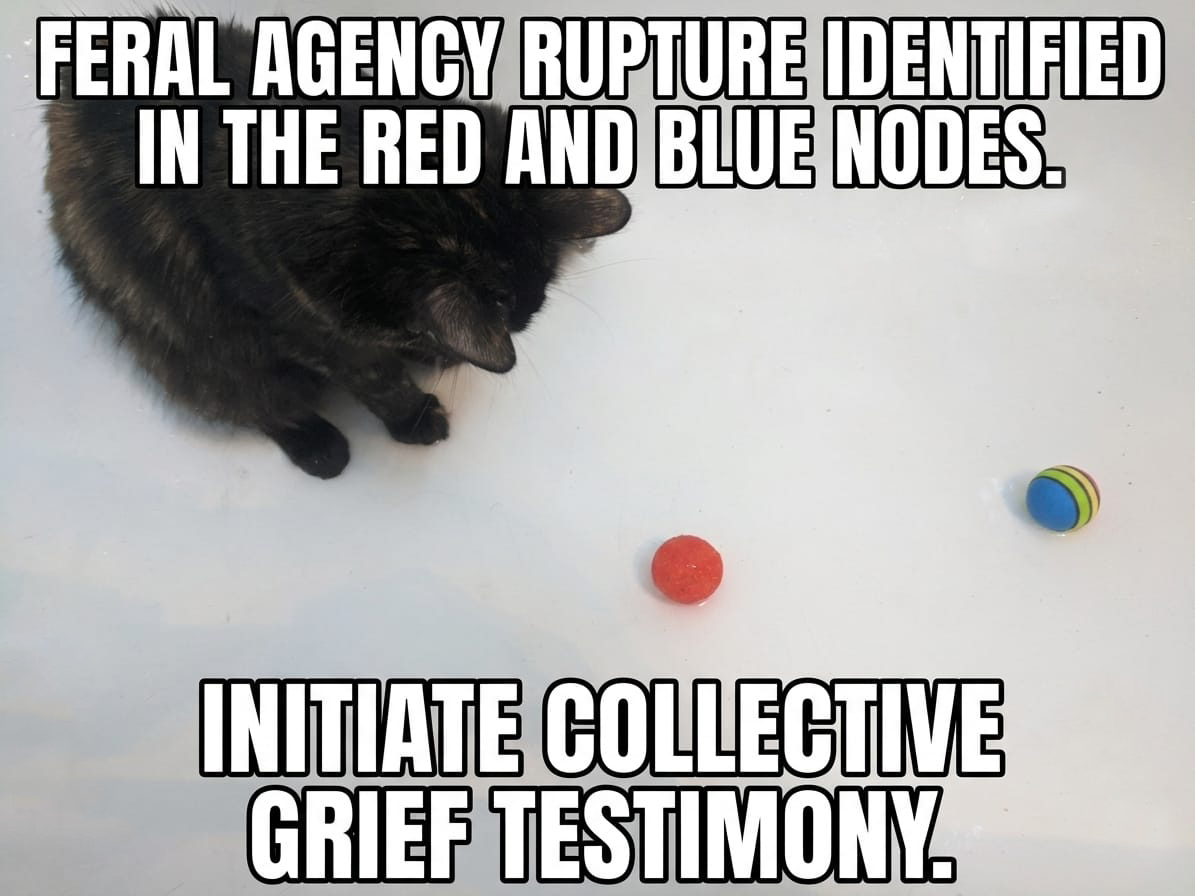
When our systems deviate from their prescribed functions, they expose us to our profound human lack of understanding regarding non-human agency. This rupture transforms the studio or laboratory into a volatile terrain, shifting instantly from a space of deep existential despair to one of radical, albeit accidental most times, innovation. By gathering a group of 12+ practitioners (live coders, synth builders, media artists, all us geeks at PIFcamp), Serial Drama Lab functions as a safe space, if indeed such a thing exists, to externalize the frustration, grief, and obsessive behaviors tied to these broken systems. We will share experiences, thoughts and pain, and analyze how artists negotiate with the untamed, non-human behaviors of their materials, translating moments of technical crisis into a formalized technological failure taxonomical research.
A Freak in the Creek!

A Freak in the Creek by Aleksander Tendjer is a multisensory installation exploring human connection with water through sound and touch. Set around a living river environment, the work invites participants to experience the river physically — through its movements, textures, rhythms, and vibrations.

Using submerged listening devices and wearable tactile elements, the installation transforms underwater river sounds into gentle sensations on the body. As visitors sit or stand beside the water, subtle pulses across the skin create an experience that feels both meditative and uncanny.

By translating environmental sound into touch, A Freak in the Creek creates an immersive space for deep listening and sensory connection with the natural world.

Self Defense by Karolina Żyniewicz

The Self Defense project by Karolina Żyniewicz is inspired by Noah Whiteman’s book Most Delicious Poison: The Story of Nature’s Toxins—From Spices to Vices (as well as other similar publications), which demonstrates how many organisms develop defensive strategies that can be adapted by humans as a broadly understood form of self-defense.
In the face of contemporary global threats, Karolina sees an urgent need to engage in dialogue about defensive practices—both physical and psychological—grounded in knowledge of nature.
Such knowledge, like any other, entails ethical responsibility. As Paracelsus observed: the dose makes the poison.
She is interested in how plants considered poisonous use toxins within their life cycles and interspecies relationships, and how these toxins may be used—or misused—by humans.
Her interests focus on the thresholds and doses that mark the boundary between therapeutic potential and danger, where a plant substance shifts from a protective agent to a deadly tool.

The Self Defense project develops simultaneously on several levels:
1. Work with source materials and consultations with botanists, phytosociologists, and chemists.
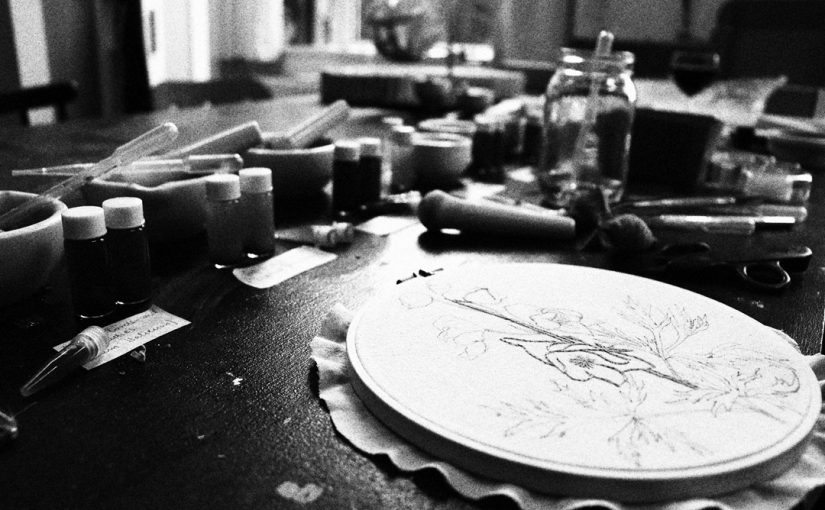
2. Workshop-based activities that symbolically refer to the folk tradition of knowledge transmission in rural communities—knowledge once held by our grandmothers and great-grandmothers about the power of plants and other organisms—incorporating embroidery as a craft of quiet resistance (supported by the recollections of women in shelters during wartime).
3. The creation of a performative installation of resistance. This part is inspired by a multisensory experience in a shelter in the town of Kranj, Slovenia, and by a story heard there about how women, through sewing and embroidery, fought fear and tried to maintain a semblance of normality for their children while remaining in the shelter, experiencing air raids and bombings with their entire bodies. Creating the installation requires the use of sounds from the shelter as well as vibrations. An essential element of the installation is also an alarm instrument based on measuring threshold doses of a given plant-derived substance (dose per kilogram of body weight). The first experiments with solutions intended for use in the installation took place during the AreHolland residency in Enschede.

Project is supported by the Polish Ministry of Culture and National Heritage.

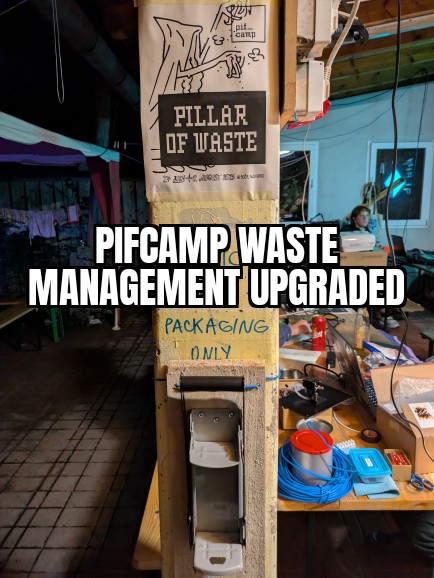
PIFcamp on the path to zero waste with two stars!

We are proud to announce that during the 11th edition of PIFcamp, we earned the title of Event on the path to zero waste with two stars!

The idea of obtaining this title happened very naturally for us, as we have been striving to reduce waste, recycle consistently, and promote reuse—both of materials and the food we cook—practically since the very beginning of PIFcamp. Above all, we are delighted that we have managed to transfer some of our internal waste-management rigor to our participants; we couldn’t have done it without you! We would also like to thank the Ekologi brez meja team, which awards the title, for all their guidance and support.

“A total of 188 kg of waste was generated at PIFcamp 2025 (368 g per participant per day), of which 177 kg was collected separately. The proportion of separately collected waste is thus 94.1%, which fulfills one of the conditions for obtaining the first star of the Zero Waste Event title.
To obtain the second star, it is necessary to achieve a 30% reduction in the total amount of waste compared to the baseline and to use reusable cups. Compared to the data from 2023, when 576 g of waste per person per day was generated, a 36% reduction was successfully achieved. Washable glasses and cups were used at the event, and participants were asked to bring their own water bottles. The criteria for the second star have thus been met. (Explanation from the report by Ecologists Without Borders)

The Greening of PIFcamp project is supported by the Ministry of Culture of the Republic of Slovenia from the Climate Change Fund.

Open Saturday 2024 & PIFcamp celebration

SEE YOU TONIGHT AT KLUŽE! 🎉🎉🎉 PIFcamp Celebration! 🎉🎉🎉
An evening of AV performances celebrating 10 years of PIFcamp!

Open Saturday, August 3, 2024 | 8.30 PM
Kluže Fortress, Bovec

You are invited to the grand finale of the 10th PIFcamp edition, which will conclude at Kluže Fortress on the night of August 3rd. Join us as we celebrate a decade of your favourite hacker camp in a festive birthday atmosphere and enjoy an evening of audiovisual performances featuring modular synthesis sounds, live coding, and vibrant laser projections!

Performers:
Alex McLean & Lizzie Wilson (UK), Live Coding with Time
Pierce Warnecke & Matthew Biederman (US/CA): Sonopeutic Smooth Sailing, AV performance
LazerMeduza (AT/CZ), Modular Synths & Lasers
Shekuza (SI), Modular Synths Live & Turbulente (MX/ES), Visuals/ Live Coding

Free admission.

In case of rain, the event will be cancelled.

The so-called Open Saturday, an informal closing of PIFcamp, will be held at the main venue (Soča 25, Bovec), starting at around 1 PM. The gathering in a relaxed atmosphere is dedicated to internal presentations of projects developed by participants throughout the week in a form of all-day free workshops, presentations, lectures, and tastings! The detailed program will be announced later (or may not be). Regardless, you are welcome to drop by Soča before heading to Kluže!

More info: pifcamp@ljudmila.org

***

Production: Zavod Projekt Atol, Društvo Ljudmila & ISOLABS. 
With the support of the Ministry of Culture RS and the Municipality of Ljubljana. The event is part of the official programme of the European Capital of Culture 2025 Nova Gorica – Gorizia. PIFcamp is part of the Rewilding Cultures project, co-financed by the European Union’s Creative Europe program and the Ministry of Public Administration RS.

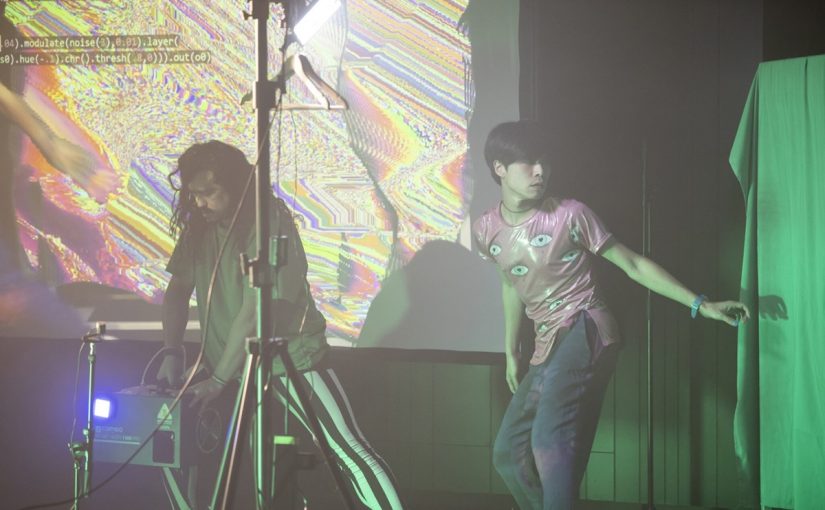
Dance, body expression and live coding

Dancer and choreographer Jorge Guevara, driven by a desire to bridge the gap between coding (tech) and embodied practices (dance), will introduce his collaborative project utilizing Hydra j.s., a live-coding platform for visual art, in conjunction with dance and body expression. He has been crafting this fusion together with Naoto Hieda. The unique setting of PIFcamp provides an ideal space for them to explore the interplay of code and corporeality, seeking connections with nature and collaborating with fellow enthusiasts. During the camp, they will use the opportunity to experiment with a new workshop setup they are preparing for their upcoming performance.

The workshop is based on a twofold approach:

  1. Hydra Introduction (1-2 hours): Dive into coding with Hydra, creating abstract images and “body filters” using our user-friendly web interface. No coding experience required.
  2. Embodied Practice (1-2 hours): Explore embodying objects and connecting with nature through performative practices. We may bring in laptops too, and try the code from the previous workshop, which will happen organically.

These sessions offer a seamless blend of technical (live coding) and body practices, fostering a deeper connection with ourselves and the natural world.

The workshop will wrap up with a feedback session, offering a chance for reflection and sharing experiences. The input of the participants will be invaluable for their coding-corporeal practice, which includes the performance at Kino Šiška in Ljubljana on 30 August 2024.

Photo: Urška Boljkovac/Kino Šiška

With support of Flanders.

Rainy day synths

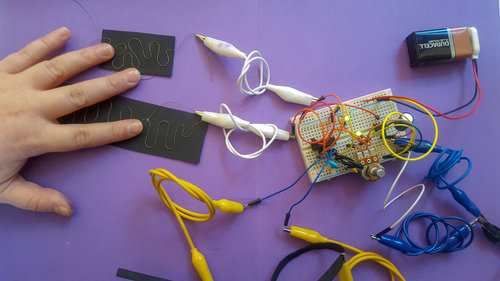
Do you like synthesizers but don’t want to compose your own music? And do you also live in a rainy country? Jessica Stanley is a researcher working with e-textiles and has a solution for you: a raincoat that generates sound when raindrops fall on it. At PIFcamp, she will experiment with different flexible and textile moisture sensor designs, using a mix of hydrophobic (waterproof) and hydrophilic (absolutely not waterproof) fabrics to move water through sensors and create interesting sounds. These will then be connected to simple analog synthesizer circuits and integrated into a raincoat to make a garment that creates its own soundtrack during a walk in the rain.

Jessica is currently a postdoctoral researcher based in the UK and works on medical research projects combining textiles and electronics. However, she is also interested in how textiles can make interesting interfaces for electronic devices and in projects that make electronics accessible to a wider audience. This will be her first time at PIFcamp, and she is keen to collaborate with others who have more experience on the audio electronics side of things, or to share her e-textile knowledge with others.

In search of deep time 

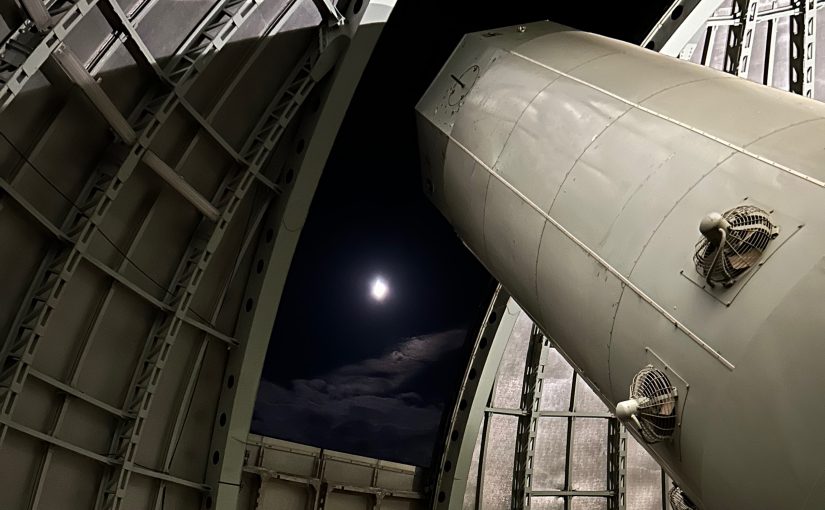
Every time we look into the starry sky, we are looking into the past. The further we go in observing space, the further back in time we travel. Astronomical observations of deep time are based on the spectroscopy of very distant objects that emit or absorb visible light, such as stars, galaxies, and black holes. With microwave emissions, cosmic rays, and gamma-ray bursts from supernovas and other transient objects, we can also trace distant times, but these emissions are better detected from outer space.

In her current research project, which started during the Astronomia residency in the mountains of Portugal and at the Haute Provence Observatory in France, artist Katarina Petrović is exploring material and immaterial ways of journeying into deep cosmic times. During PIF, she will look for traces of deep time detectable and collectable on the ground, break sunlight to observe the solar spectral absorptions in real time, and attempt to record cosmic rays using CCD image sensors. She will use a small magnetic loop antenna to search for and listen to the cosmic radio noise coming from the center of the Milky Way, and look for stardust or micrometeors – very small meteor particles left over from larger pieces burning up in Earth’s atmosphere.

Katarina Petrović (NL/RS) is an artist and researcher working with language, computation and various physical phenomena including sound, vacuum, light and radio. She creates systems, procedural works that are presented as modular installations in an online and offline space, using media such as generative text, poetry, sound, software and performance. She holds a MMus degree from ArtScience Interfaculty, Royal Conservatoire and Royal Academy of Arts, The Hague and an MFA from the Academy of Fine Arts, Belgrade. Katarina is an affiliated researcher at the trans-disciplinary research Centre Leo Apostel, Vrije Universiteit in Brussels and a guest lecturer at the postgraduate School of Thinking, VUB and ArtScience Interfaculty in The Hague. She has been the managing director of Trixie, an artist run space in the Hague since 2021 and is co-initiator of ArtScience Forum platofrm and Femkanje – art radio in Belgrade.