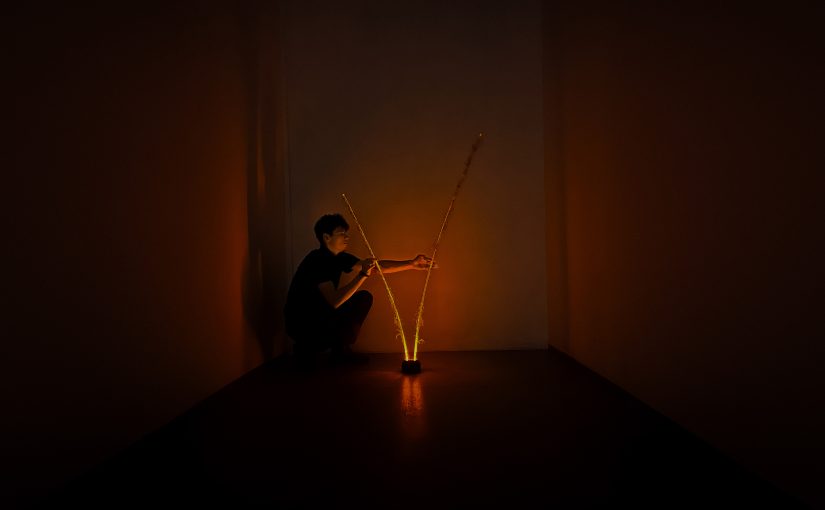
The project builds on a line of research into electronic organisms, now situated within the context of a natural ecosystem. Antonín Kindl is interested in how technology can operate within a landscape in a way that does not create a separate, additional layer, but instead becomes an integral part of the systems in which it is embedded. The Antennae function as instruments of translation, capturing phenomena occurring at frequencies and scales beyond direct human perception and transferring them into a slower medium that visitors can observe and experience.
Each unit is conceived as a static electric organism placed on the ground. It consists of two vertical light-guiding antennae that communicate through light or sound, as well as sensory roots – interchangeable probes that provide the machine with sensory access to the surrounding ecosystem. Through these sensors, the organism can perceive bioacoustic activity in the soil, contact vibrations on nearby surfaces, humidity and light conditions, and potentially also chemical or spectral inputs.
The long-term aim is to develop the units to a point where they can operate autonomously, powered by solar energy, requiring no ongoing maintenance, and communicating with the outside world only when there is someone present to receive their signals. At the same time, they can continuously record underground activity and build a local archive of environmental data. Over time, Antonín Kindl intends to expand the project into a distributed network of multiple objects embedded in the landscape, exchanging information with one another and forming a shared technological ecosystem.