What is the technical functioning behind a clock and how could we attune ourselves to other means of time-framing? This project aims to experiment with the construction of time-telling devices in order to understand how we might relate differently to time. Our bodies are attuned to clock time – a precise rhythm based on the second, made possible by the oscillation of a quartz crystal. Through piezoelectricity, the crystal marks each second by vibrating 32,768 times – a precise and pervasive count that can be replicated anywhere.
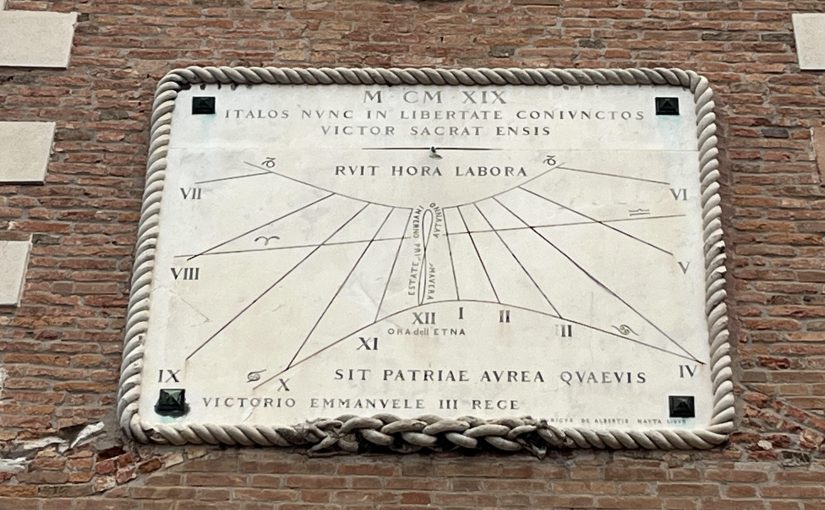
Older time-framing techniques involved following the course of celestial bodies such as the sun, the moon, or the stars, which required situated time-telling devices to compute time locally. Sundials are designed according to their location; the slow movement of the shadow offers a direct, gradual experience of the sun’s motion and the passage of time. Depending on their size and arrangement, some time-telling structures, such as Jantar Mantar in India or Stonehenge in Britain, offer a collective or embodied experience of time measurement.
Over the course of the summer camp, this project will experiment with building situated time-telling devices to experience the passage of time differently, combining analogue and digital elements. What rhythms do we want to attune to, and how do we want to materialize the experience of time’s passage within the setting of the Soča Valley? This is an experimental, hands-on project that will evolve throughout the week and be shared as a workshop.
Coralie Gourguechon is a designer and PhD student in Experimental Research through Design, Art, and Technology at the Free University of Bozen–Bolzano. Her thesis, Counting the Stones in My Computer: Unmaking the Chip Reality, explores the multiple temporalities of the microchip through its material arrangements. Through the unmaking of the chip, she seeks to understand the realities behind its manufacturing processes.