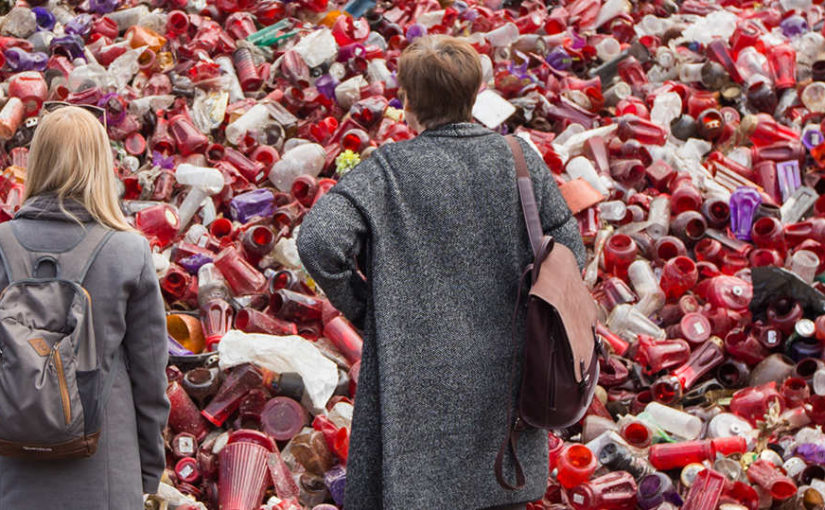
PIFcamp joins forces with a local NGO Ecologists without Borders who will provide a more circular event and shed some light on the issue of waste. During the camp they will also focus on further developmentent of the carbon footprint calculator for PIFcamp participants and other events which are part of Rewilding Cultures project. Its aim is encouraging participants toward more sustainable mobility and assessing the total level of transport-related emissions.
Ecologists without Borders is a non-profit founded in 2009 and one of the leading Slovenian NGOs dedicated to improving the state of our environment — focusing on efficient resource use and active citizenship; and implementing the concept of zero waste on several levels – individual, municipal, governmental and within organizations — including cultural ones. Jaka Kranjec, who will join PIFcamp, is their expert on policy, and a researcher of the useless world, a developer of open source solutions and a lover of puzzles who believes in free access to knowledge in the spare time.
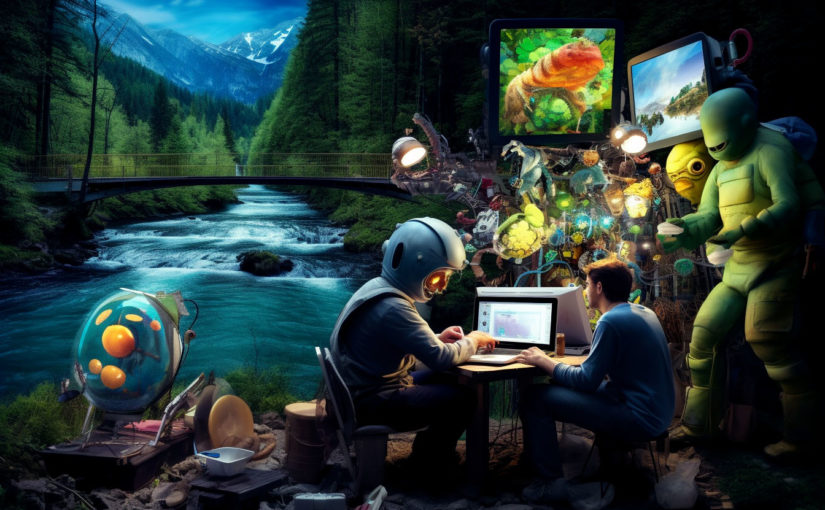
Nejc Trampuž, a young multimedia artist from Slovenia, will host a workshop on creating art with the help of artificial intelligence tools that he has been using in his work for the past year and a half. He will mainly introduce tools that enable generation of animations: the open-source Stable Diffusion (Deforum, ControlNet) in Automatic 1111 WebUI. The workshop will also be a space for sharing knowledge of others among participants and for discussing the society of the future that artificial intelligence brings on one hand, and the ecological threat on the other.
In addition to the workshop his goal is to work on his project with the working title “We Must First Listen to the Trees,” which is being developed under the scholarship from the Slovenian Ministry of Culture. The emerging short experimental generative animated film, created with the assistance of artificial intelligence – both in terms of the screenplay and animation – will reflect society in relation to the environment and ecosystem. It will conceive and present sustainable and environmentally friendly ways of living.
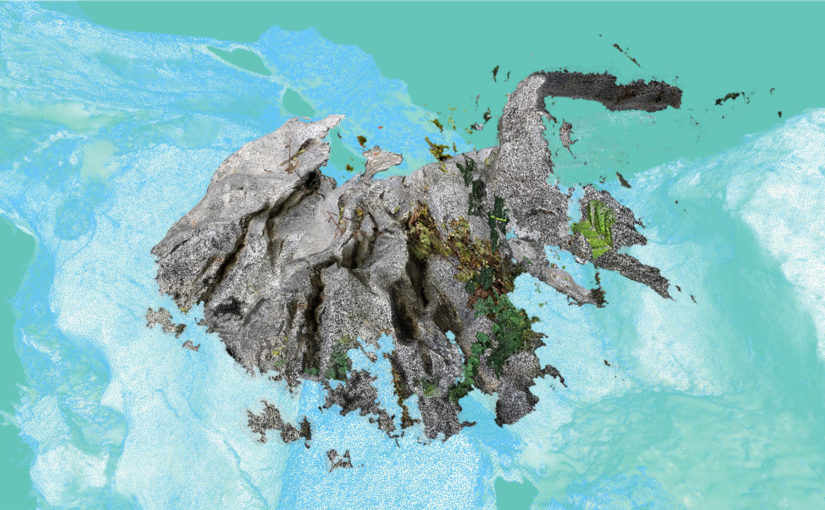
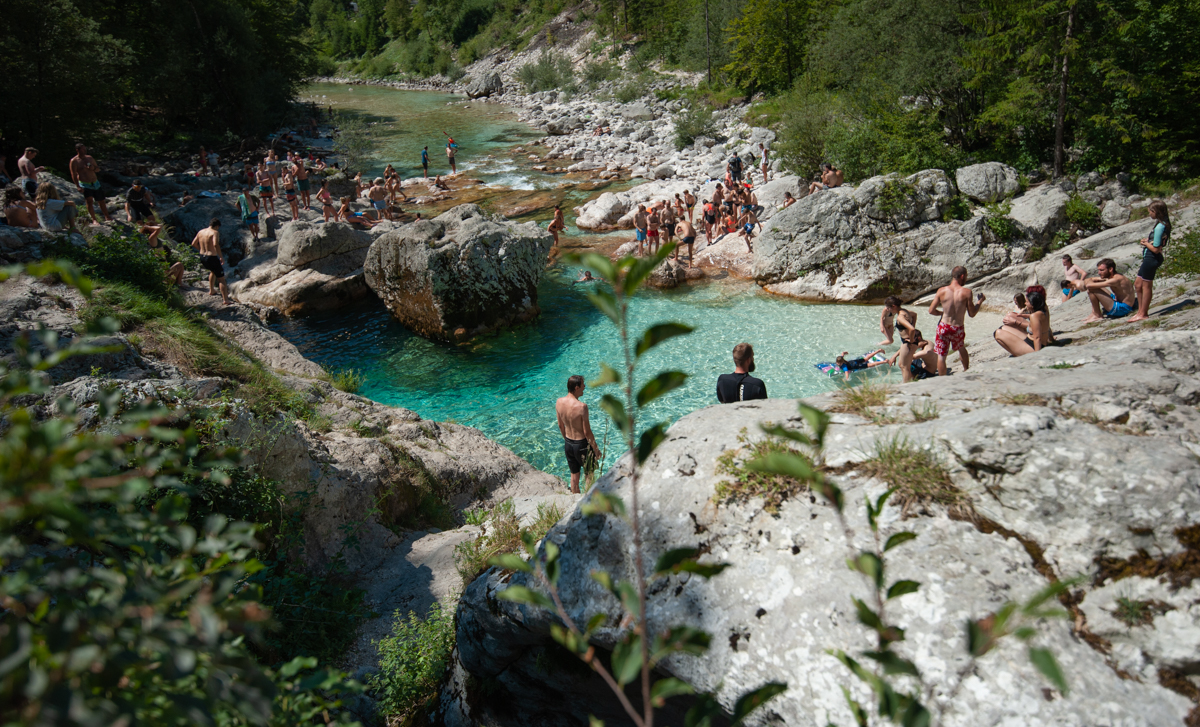
The project aims to engage with water scarcity and real-time visual storytelling to speculate on climate futures of the Soča River in Slovenia. The bed of the glacial river has been shaped by its waters in remarkable geological formations for millennia. Recently the river’s water level has been low due to summer drought, a consequence of anthropogenic factors. The project looks at the interplay and relationship between humans and the river’s geological processes. It reflects on changing ecologies and raises awareness for the conservation of this important water ecology through speculation. The project aims to use 3D scanning and photogrammetry to create a digital extension of the Soča landscape with particular attention to the dry riverbed and glacial rocks. The digital landscape will be linked to sensors placed in the landscape recording various parameters in real-time (landscape sound, water level, pollution, rainfall) which will create distortions and deformations within the digital landscape.
Swamp_Matter is a duo consisting of Eva Garibaldi (designer & researcher) and Ana Laura Richter (artist & dramaturg) motivated by a shared passion for exploring the complexities and mysteries of amphibious landscapes. Their work is driven by a deep curiosity about the relationship between humans and nature, and the ways in which this relationship is constantly evolving. Through their projects, Swamp_Matter seeks to challenge the perception of unstable landscapes as stagnant and lifeless places, and instead, highlight the rich biodiversity and ecological significance of these often-overlooked environments.
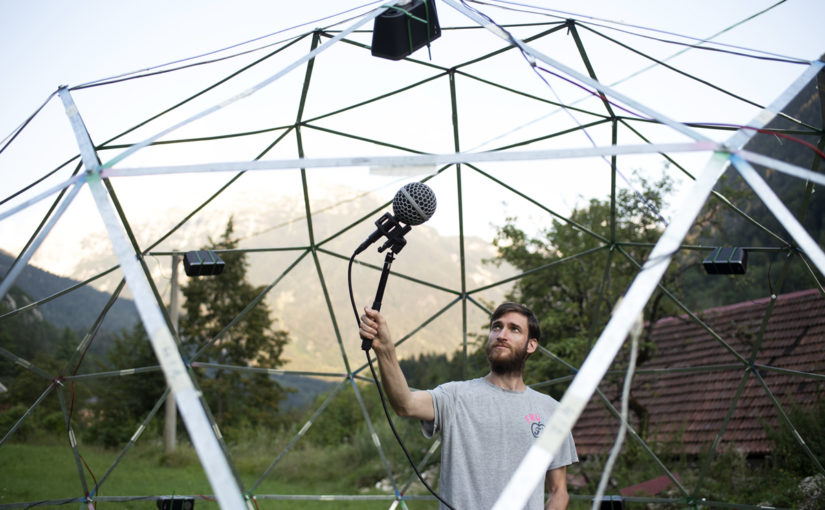
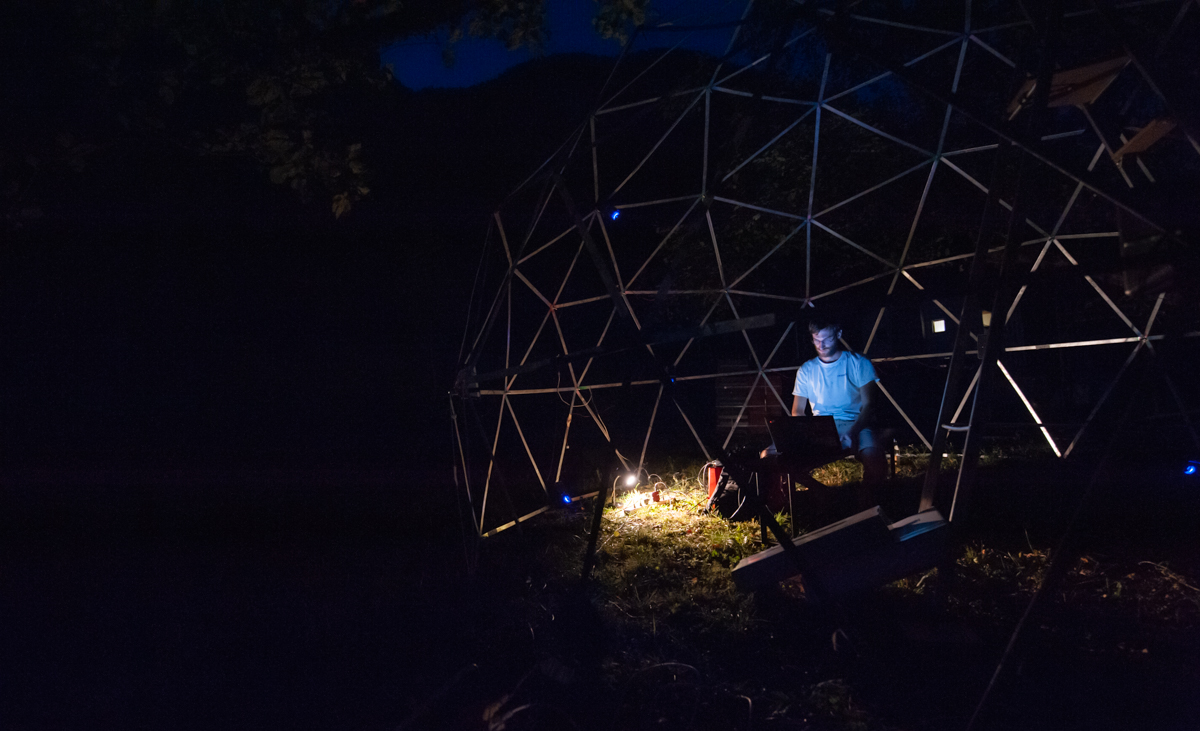
The Immersive Sound Dome is a project of Blaž Pavlica, which he has been developing for the last years and upgrading every year at PIFcamp. The project was developed out of a desire to create immersive sound, but also as an experiment in how to create such an environment with limited resources – when the project started in Slovenia, this option was not yet available. The latest version consists of a geodesic dome (designed by Staš Vrenko), 16 loudspeakers and a computer.
We invite you to submit your idea for a PIFproject that will be able to come to life in the Immersive Sound Dome with the technical support and mentoring of Blaž Pavlica. Your proposal can be anything related to immersive sound (music composition, algorithms, synthesis…), but we also welcome slightly different projects, such as lighting or decorating the dome.
For more information contact the author: blaz.pavlica[at]gmail.com
Open call for the 9th edition of PIFcamp is out! You can find all the information on how to apply in the APPLY HERE menu section. Catch the early bird price by applying until March 31st. Open call will be open until end of April.
Looking forward to build PIFtopia in Soča this summer!
Bittersweet would be a perfect term to describe the last day of PIFcamp. This year’s Open Saturday started out to be more of an Open Skies Saturday, but that didn’t stop us from making the most of it.
Part 1: Morgenspaziergang to the river
Vivian’s and David’s watermill near the Soča river. Photo: Simão Bessa
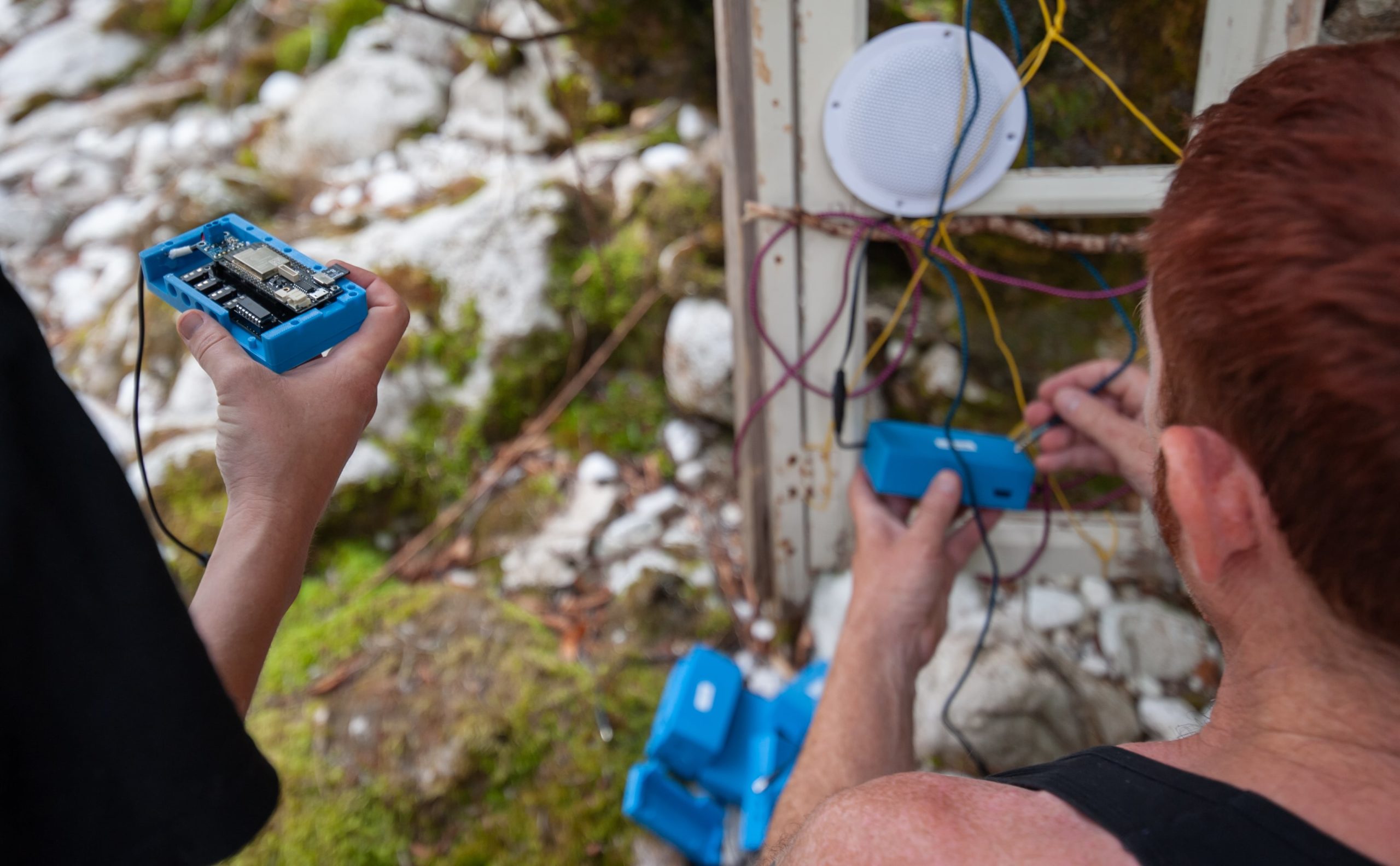
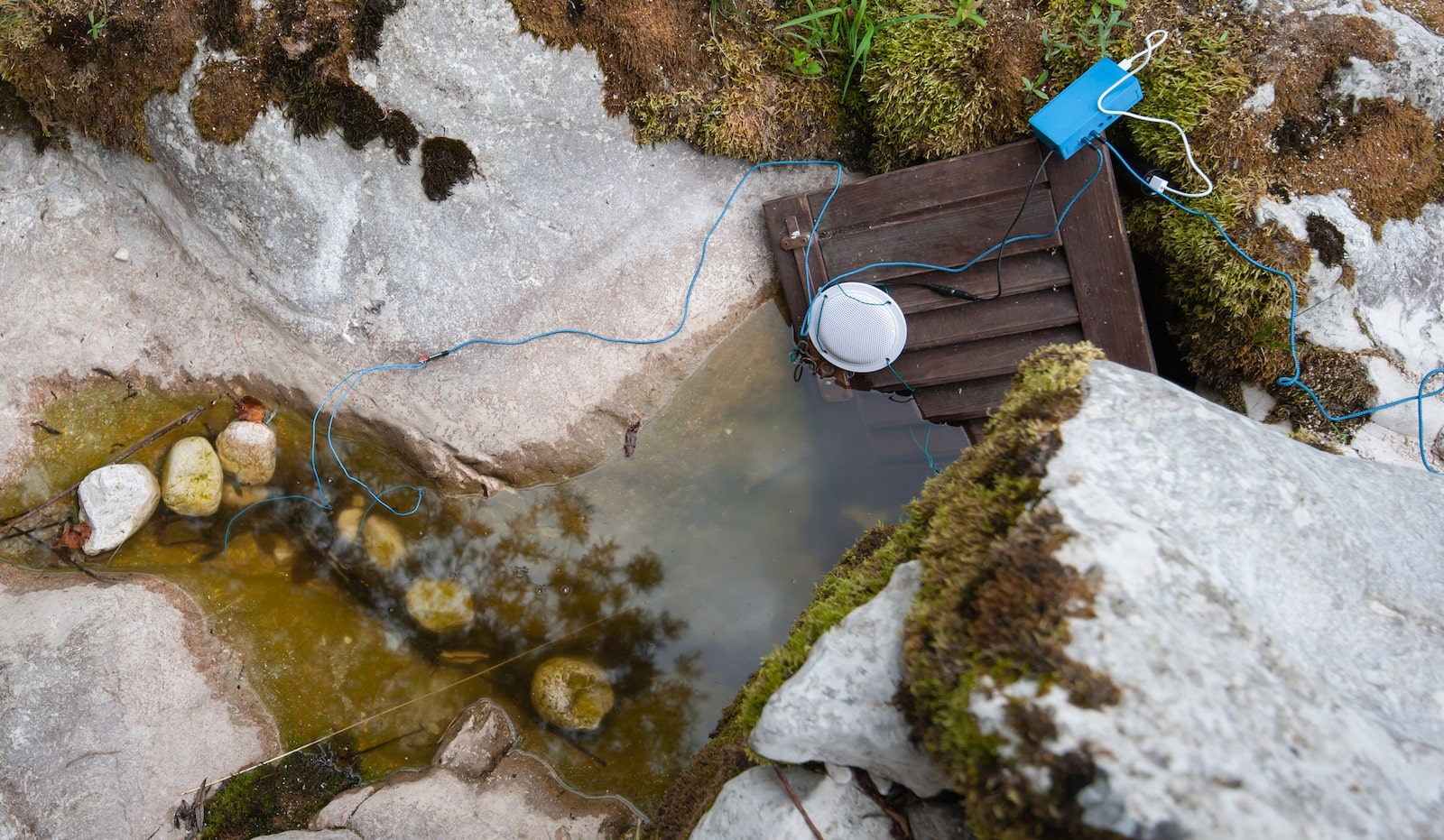
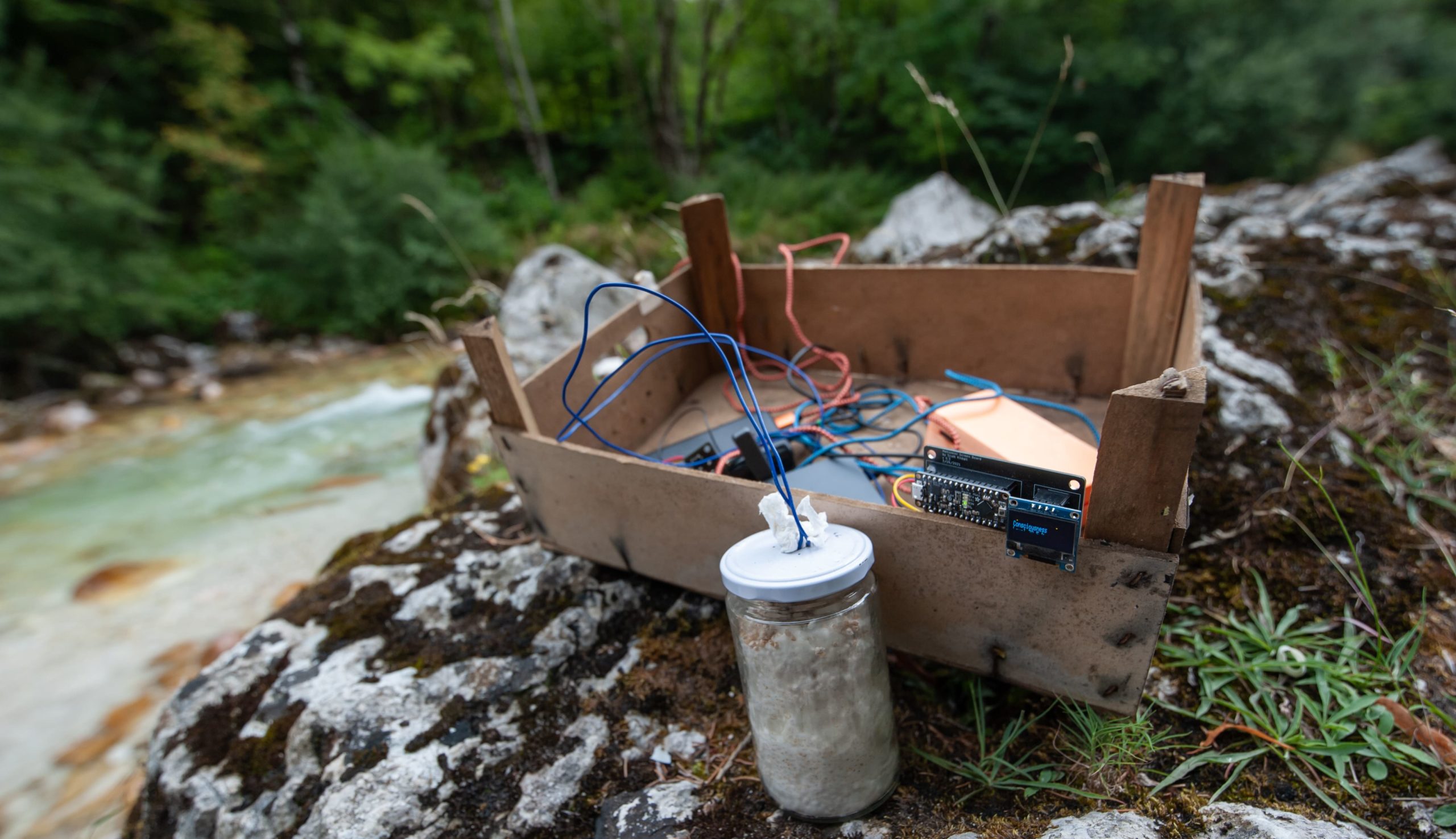
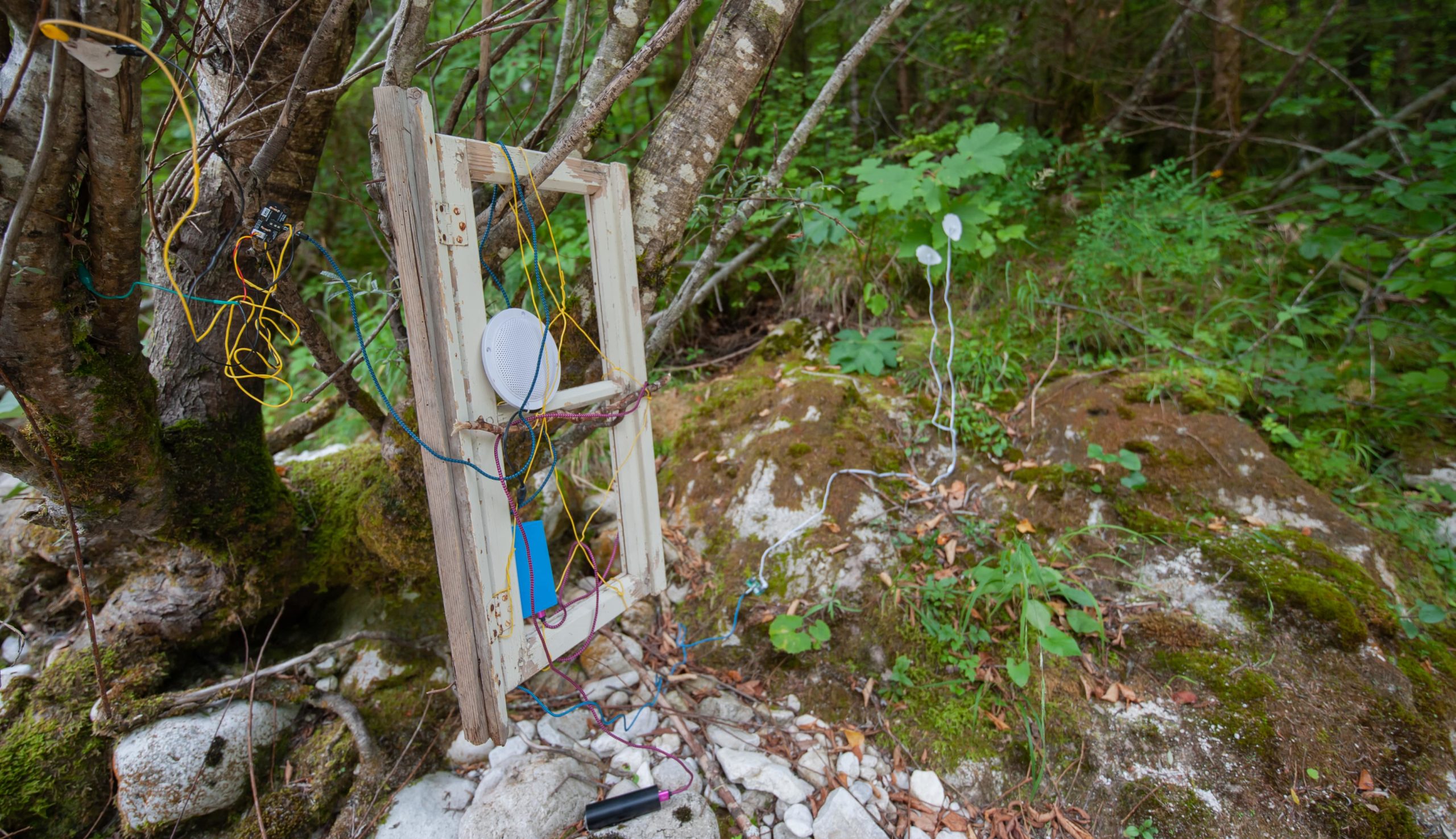
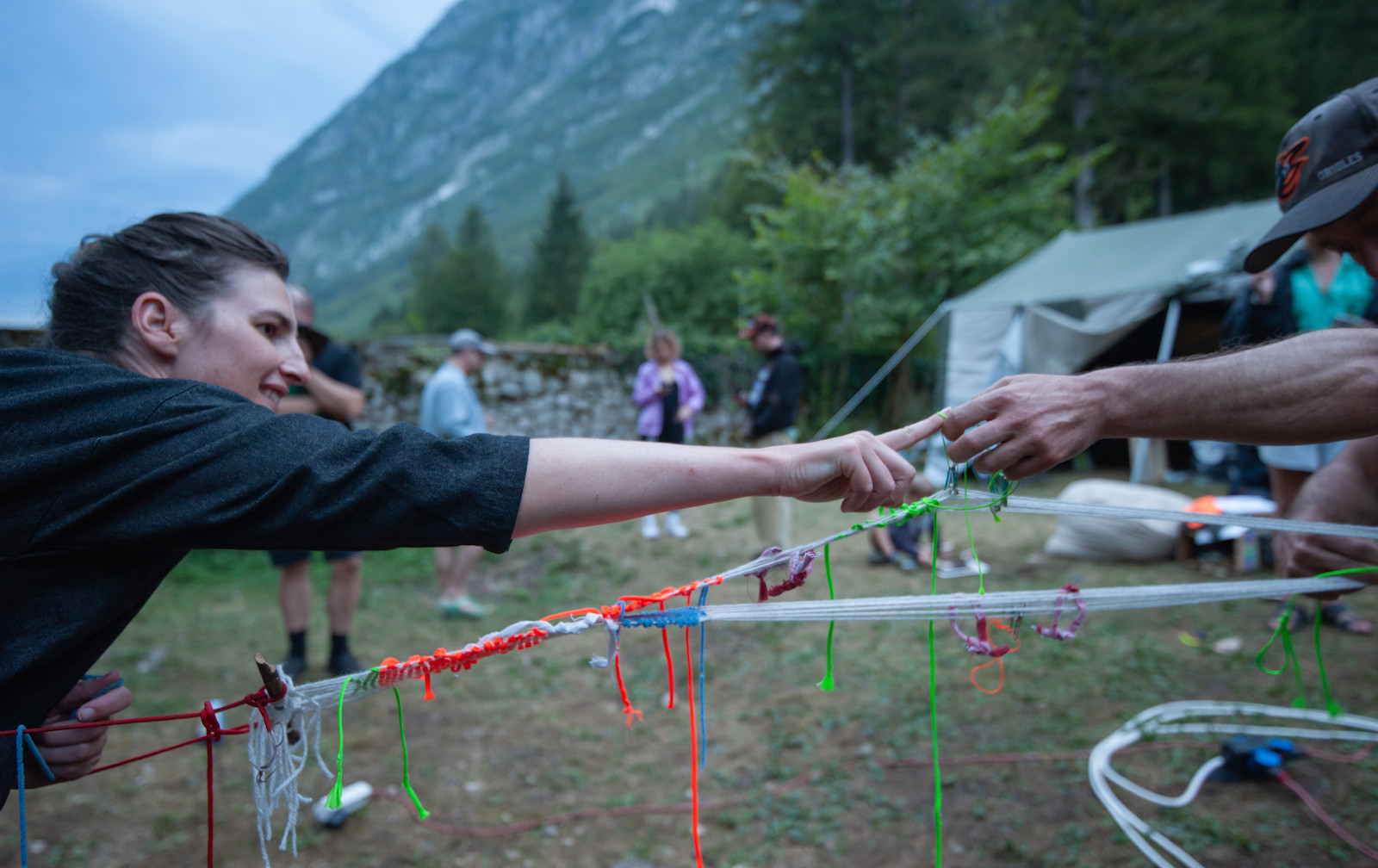
It is hard not to get inspired by the beautiful river of Soča and its surrounding nature, so after a week of hard work, some of the participants decided to install theirs on the riverbanks (and in the stream), and invite everyone for a walk down to the river. Vivian and David planted their watermill for generating electricity from the river and converting signals into sound. Upstream, Seamus installed his orchestra (made up of a mycelium conductor and plants/water/lichen musicians) with various sensors and speakers placed on debris from a building site near PIFcamp, which translates sensory data and signals into glitchy synth music to evoke nature’s distress.
Seamus aka Scott Kildall puts his orchestra on display. Photo: Simão Bessa
Part 2: Raining cats and dogs (and T-shirts)
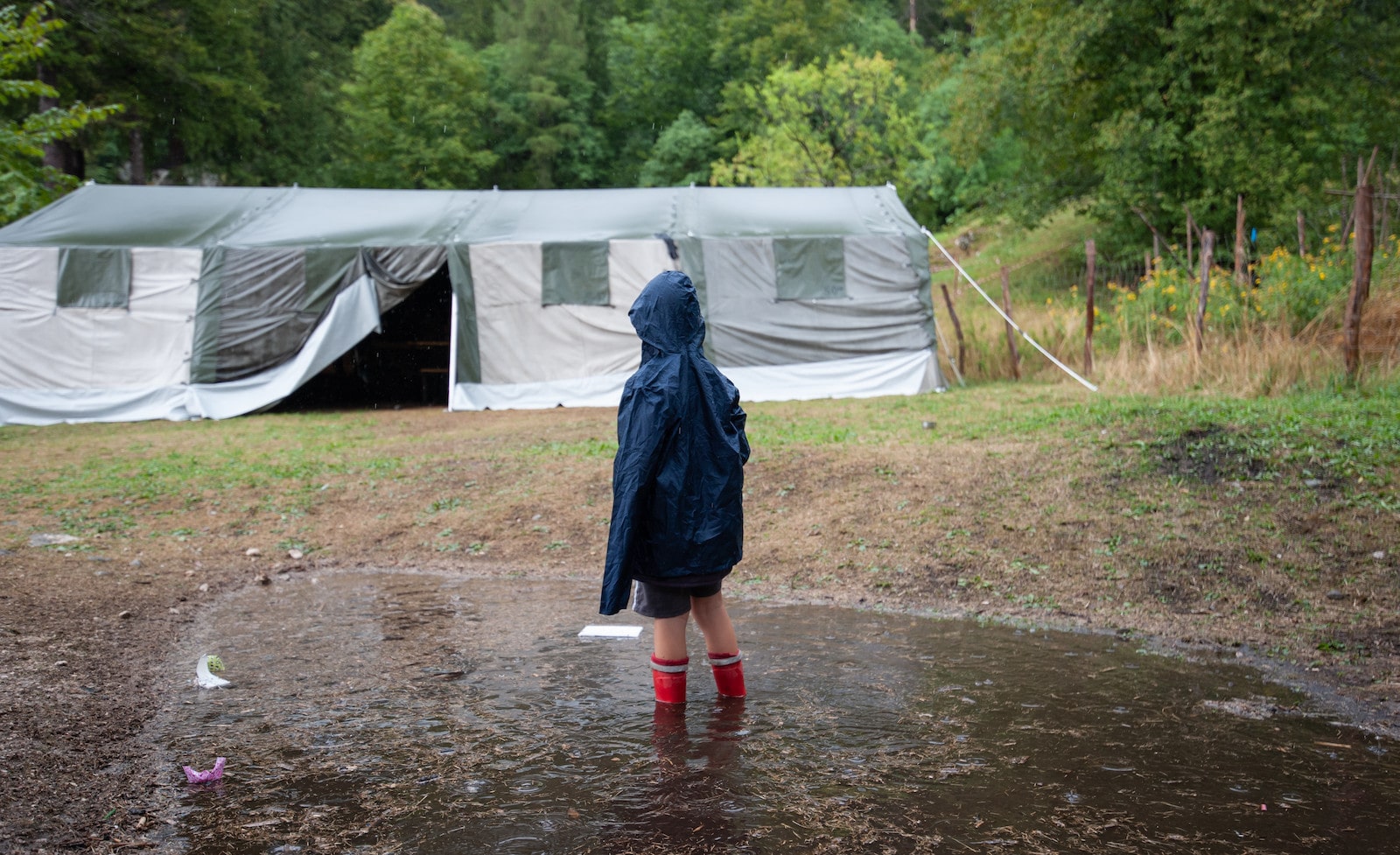
The PIF Lake. Photo: Simão Bessa
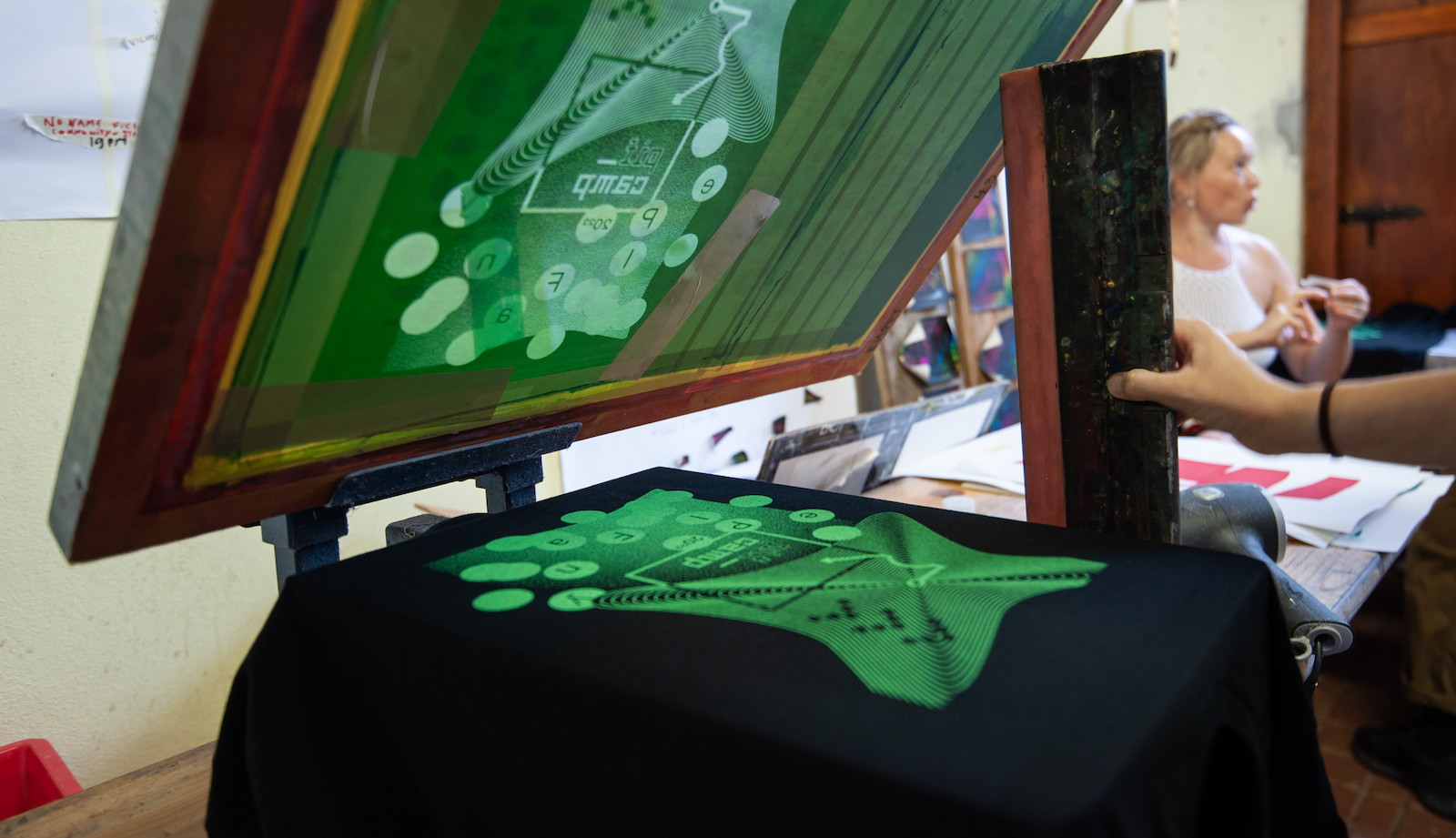
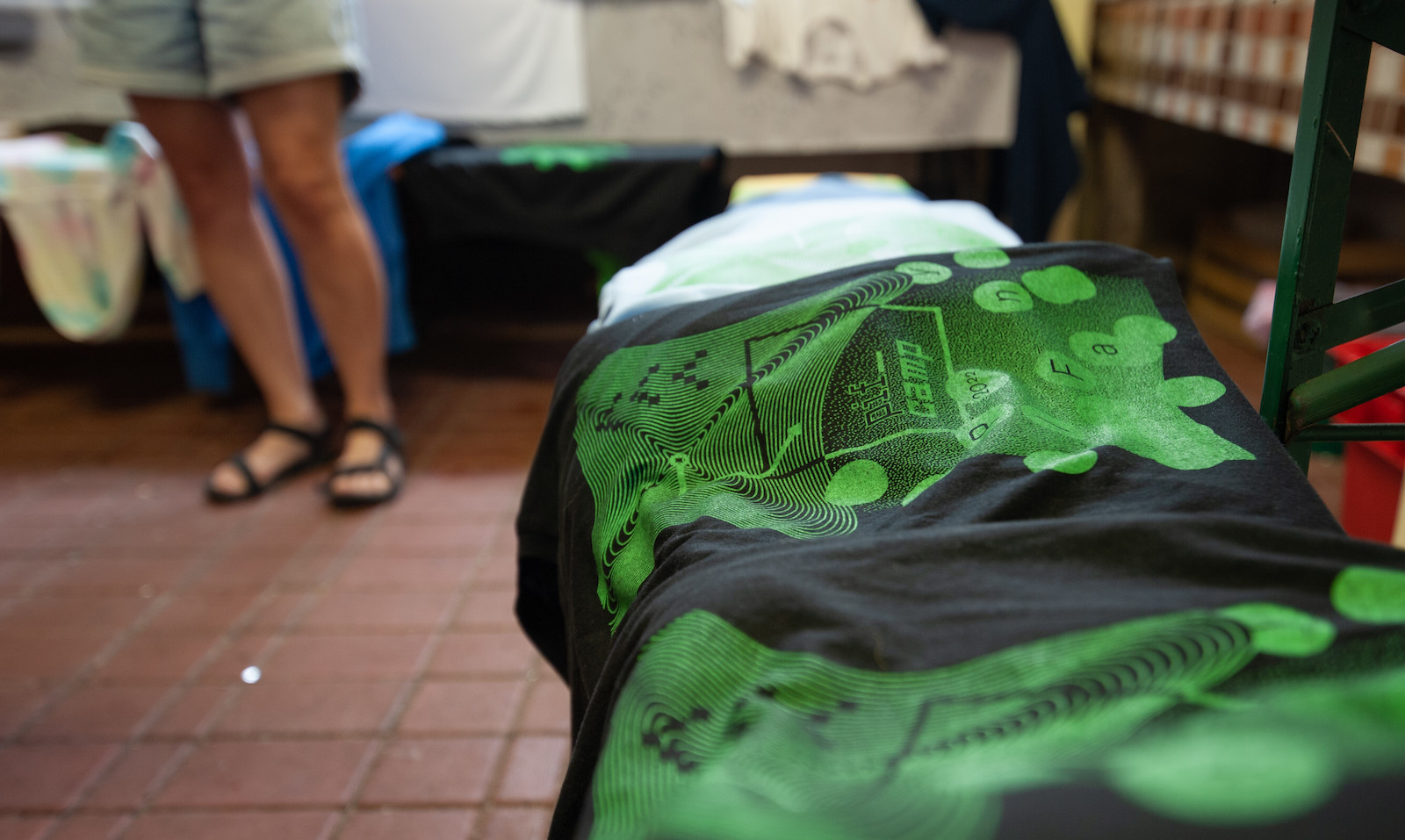
Riverside activities had to be wrapped up quickly as the rain started to pour… While the youngest enjoyed themselves in the newly formed lake, Urška was hard at work screenprinting approximately a hundred T-shirts with this years’ PIFcamp motifs.
T-shirts printed by another PIFcamp regular, Urška. Photo: Simão Bessa
Part 3: Mains hum ePIFany and other community activities
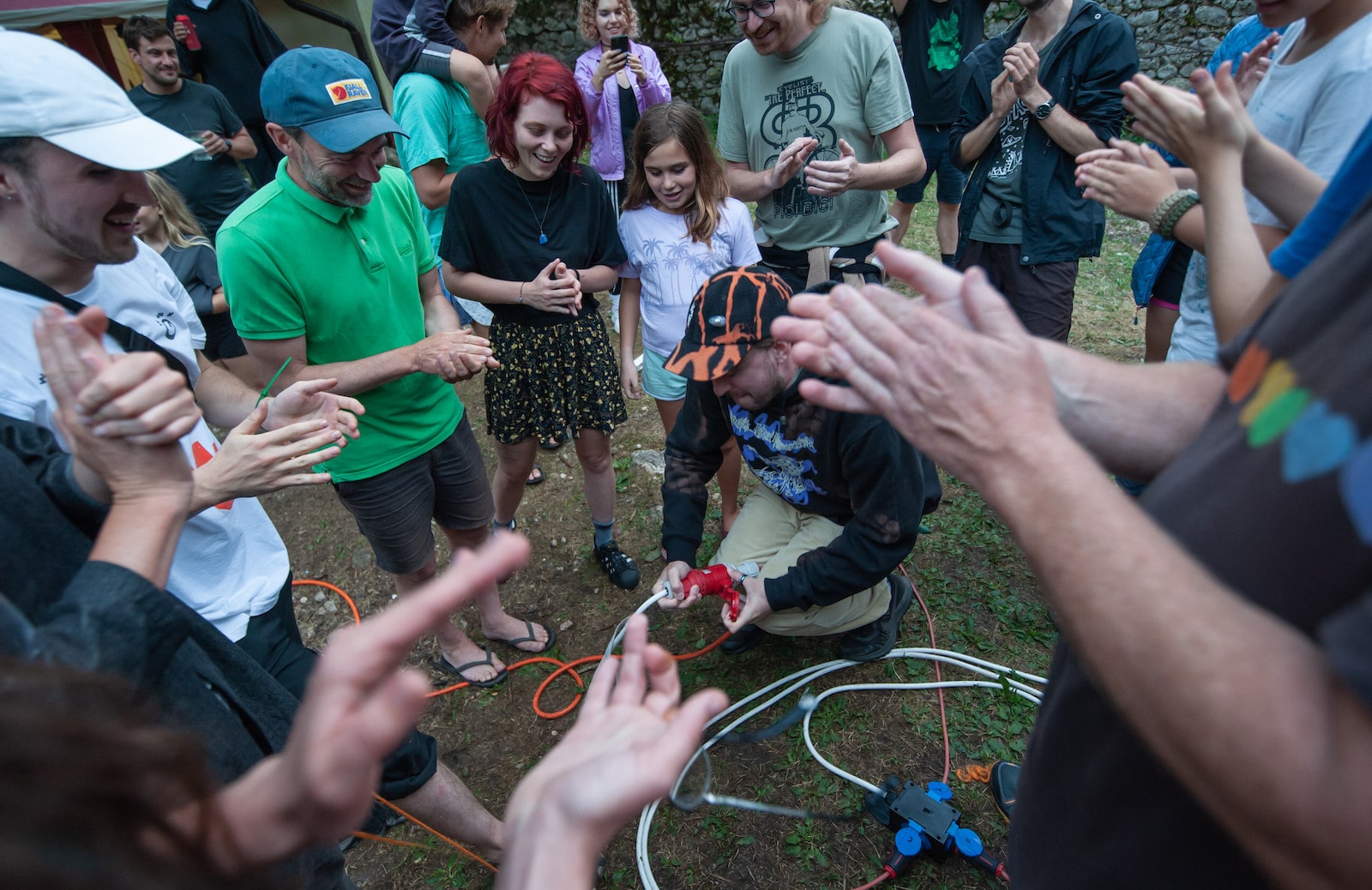
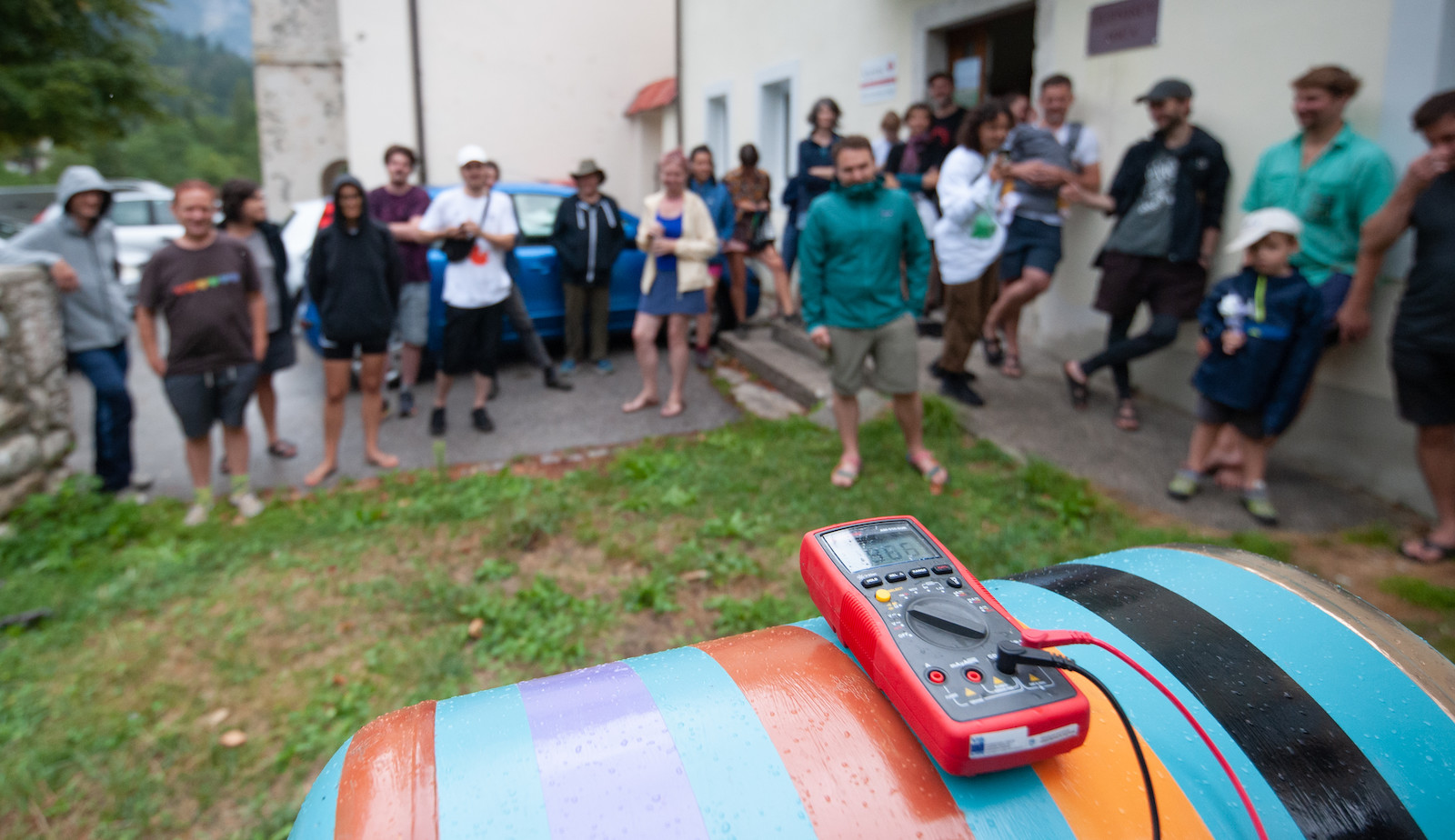
All hail the 50 Hz! Photo: Simão Bessa
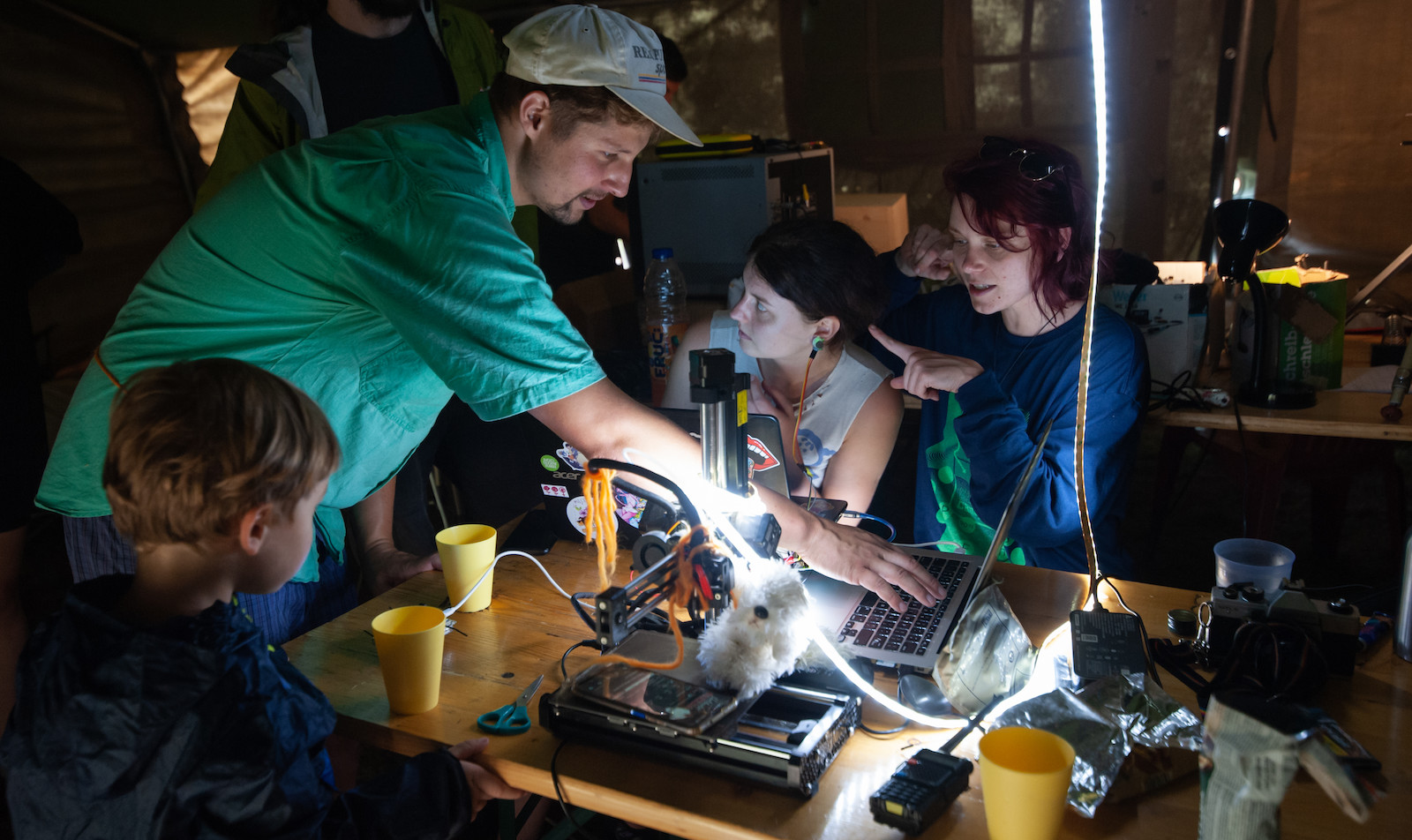
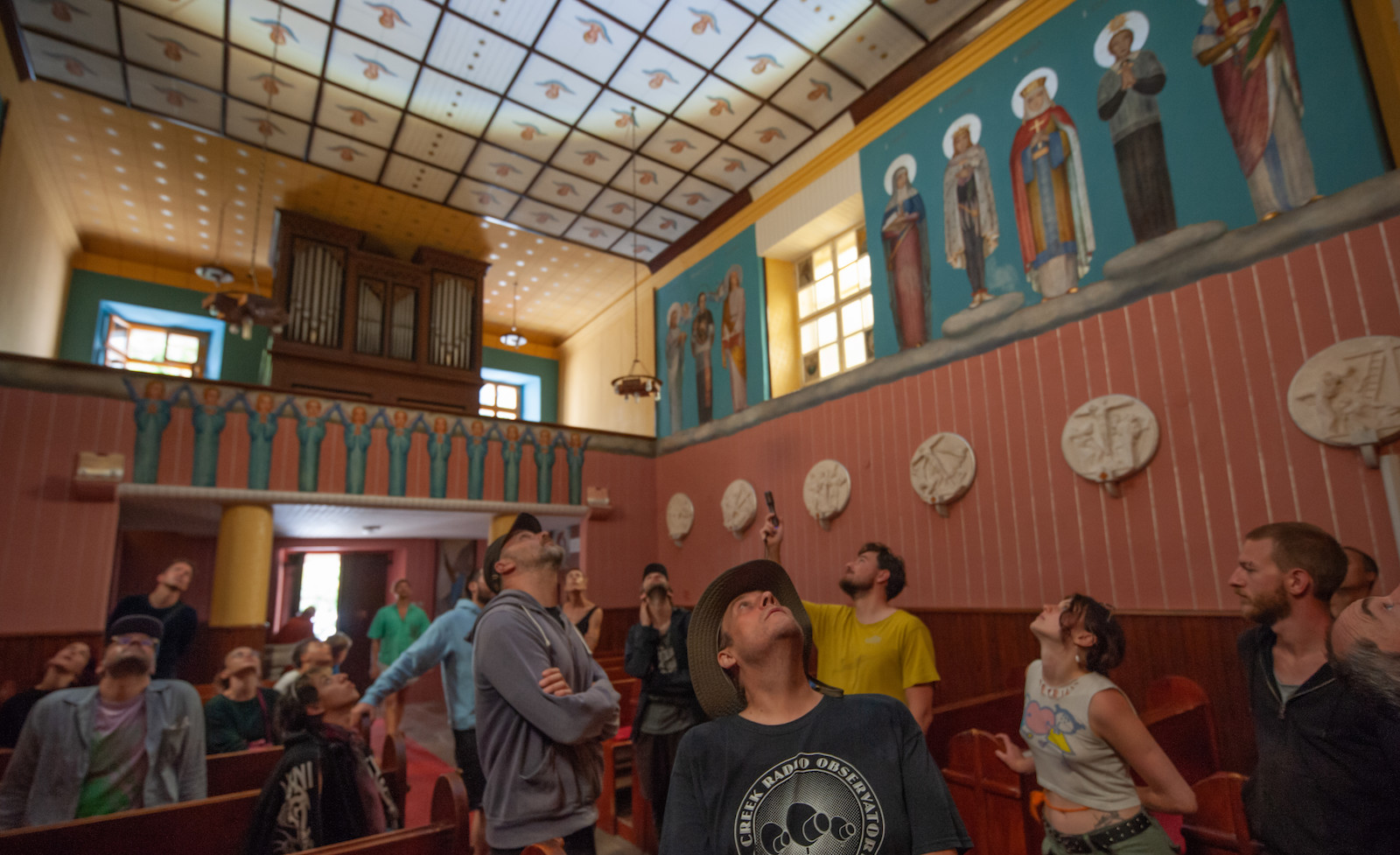
After the rain stopped, PIFparticipants continued with presentations of their projects, formed a 50 Hz cult, and engaged in a community broadcast. We figure this is as good as any spot to thank the amazing PIFcamp kitchen crew for their weeklong service, crowned by the Saturday’s banquet. Thank you!
Community activities from presenting projects to performances and a guided church tour. Photo: Simão Bessa
Part 4: Dance the PIF away
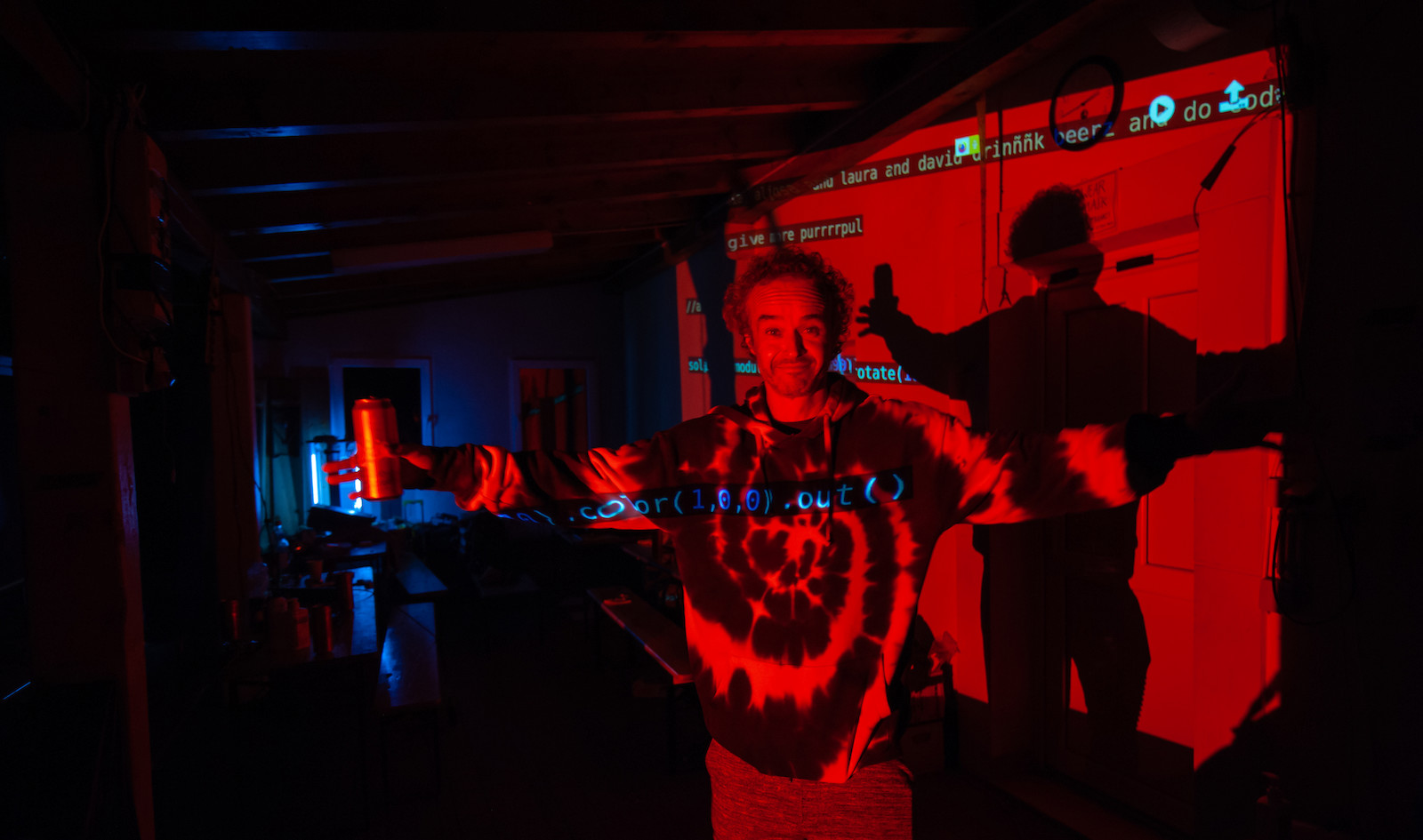
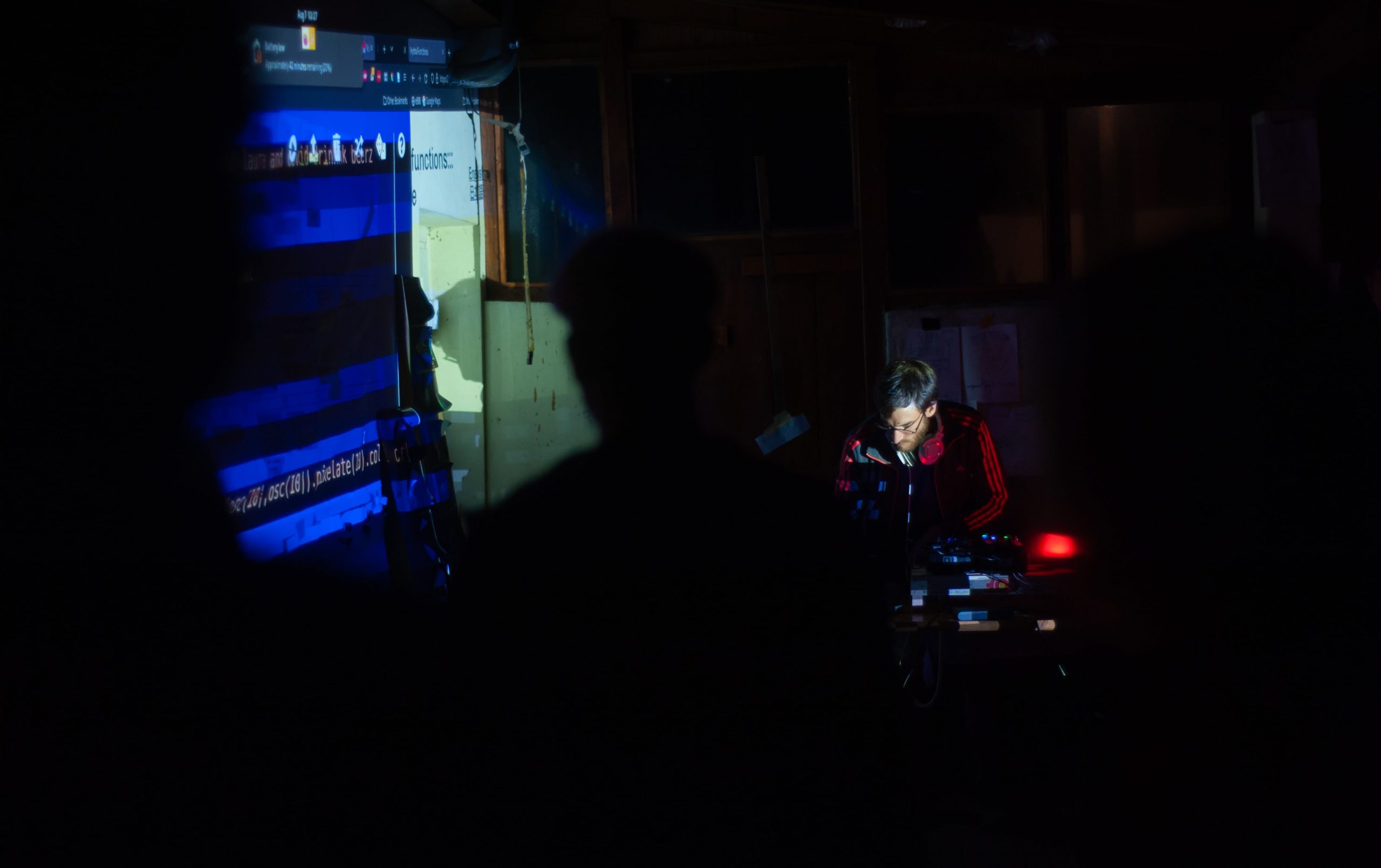
Our incredible video team set the tone for last night at PIFcamp with the world’s premiere of two short video documentaries (ISOLABS and Live coding) made from scratch during the past 6 days. After a quick change of the tent’s function from a cinema to a concert venue, the crowd enjoyed Bernhard’s and Mitja’s performances accompanied by Aljoša’s visuals, and was thus well prepared for a night of clubbing. Under the canopy, a wonderful lineup of live coders programmed their dance steps at the (probably world’s first) terrace algorave, followed by Blažen DJ’s blissfully eclectic mix. And so, we danced the PIFcamp goodbye. Until next year!
Thursday took its toll, at least on the most persistent ravers and the drink supplies. The PIFlogger didn’t spare any energy either, so she’s using visual materials to help her gather her impressions today. So what did Friday looks like at PIFcamp? Friday is the day when PIFers have one last time to try out new approaches, wrap up their projects (and side-projects) or come to terms with a (non)working prototype and get ready for Open Saturday, which was back on the schedule after another round of negative tests. But first, it’s time for the mandatory! hike and a close encounter with the freezing Soca (this year’s river temperature is a noticeably lower 12 degrees).
Photo by Simão Bessa
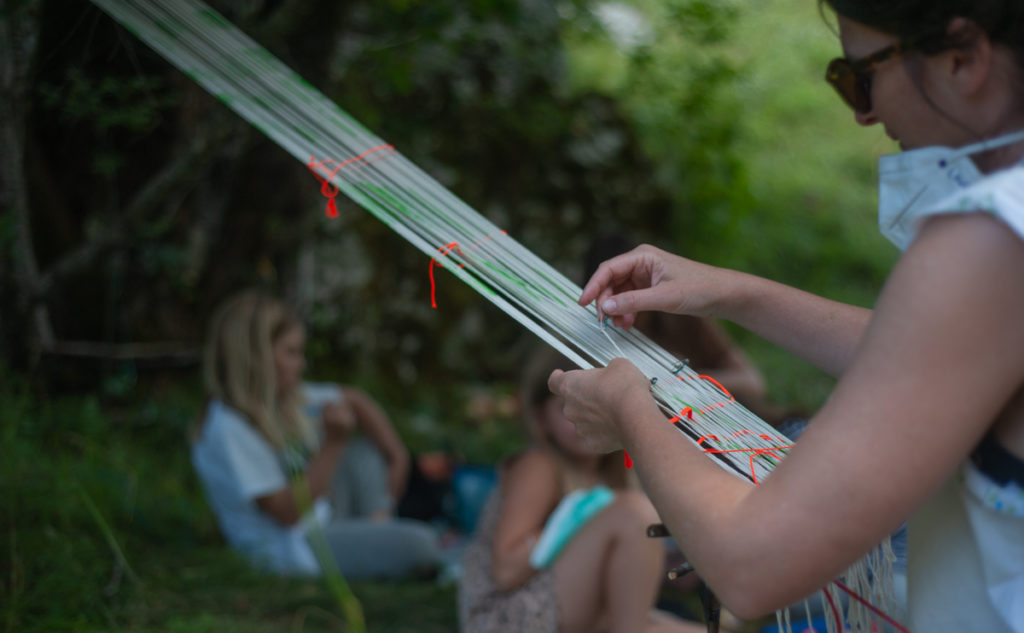
Swimming in the Soča is one of the best ways to reset, so most participants managed to get back to their normal rhythm after lunch. For those who wanted to take it easy while developing their handcraft skills, Becca and Margo’s animal embroidery workshop was a perfect choice.
Embroidery workshop. Photo Simão Bessa
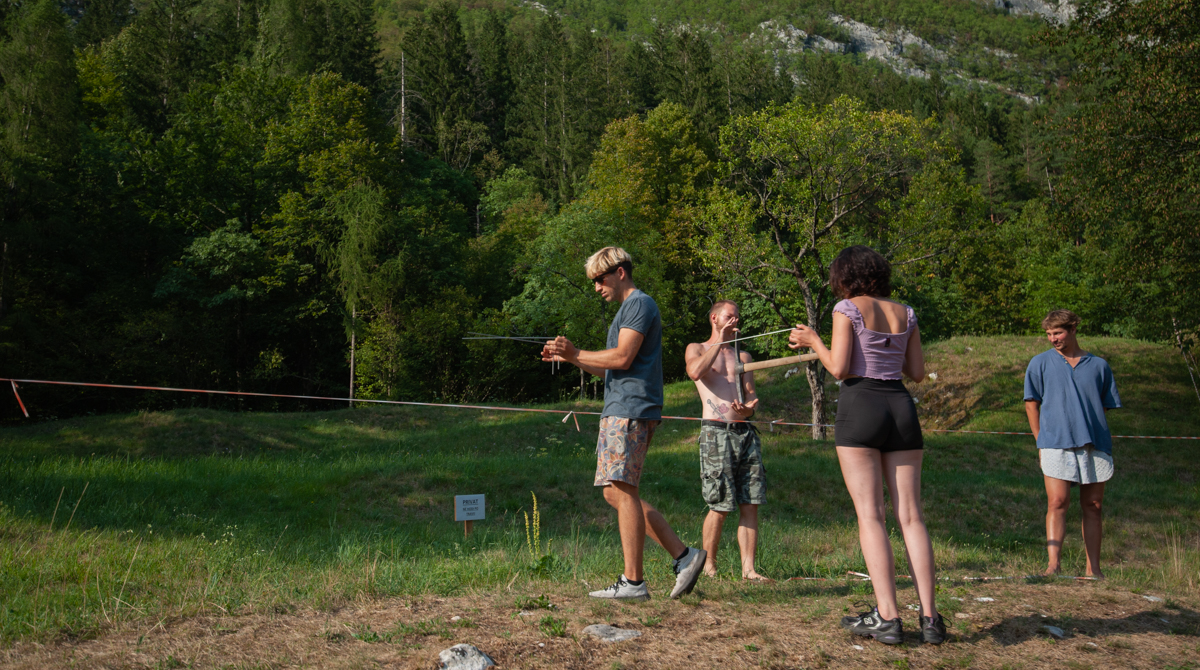
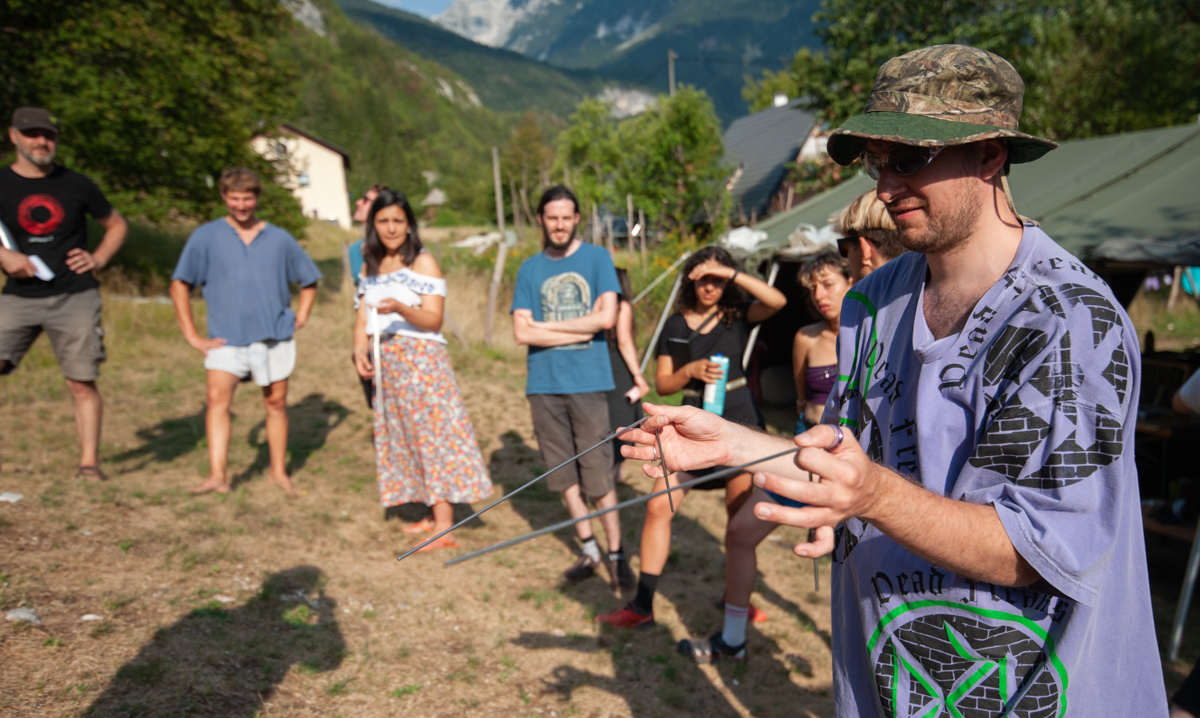
“Follow the cable” could be the guiding principle of the next activity organised by Simon, a member of the Octosens team, who invited participants to explore the underground installations around PIFcamp with dowsing rods. Judging by the happy expressions on their faces, one could dare to say that you make a PIF person happy in an instant if you put a piece of metal in their hands.
No cable is hidden or safe enough for the PIFcampers. Photo by Simão Bessa
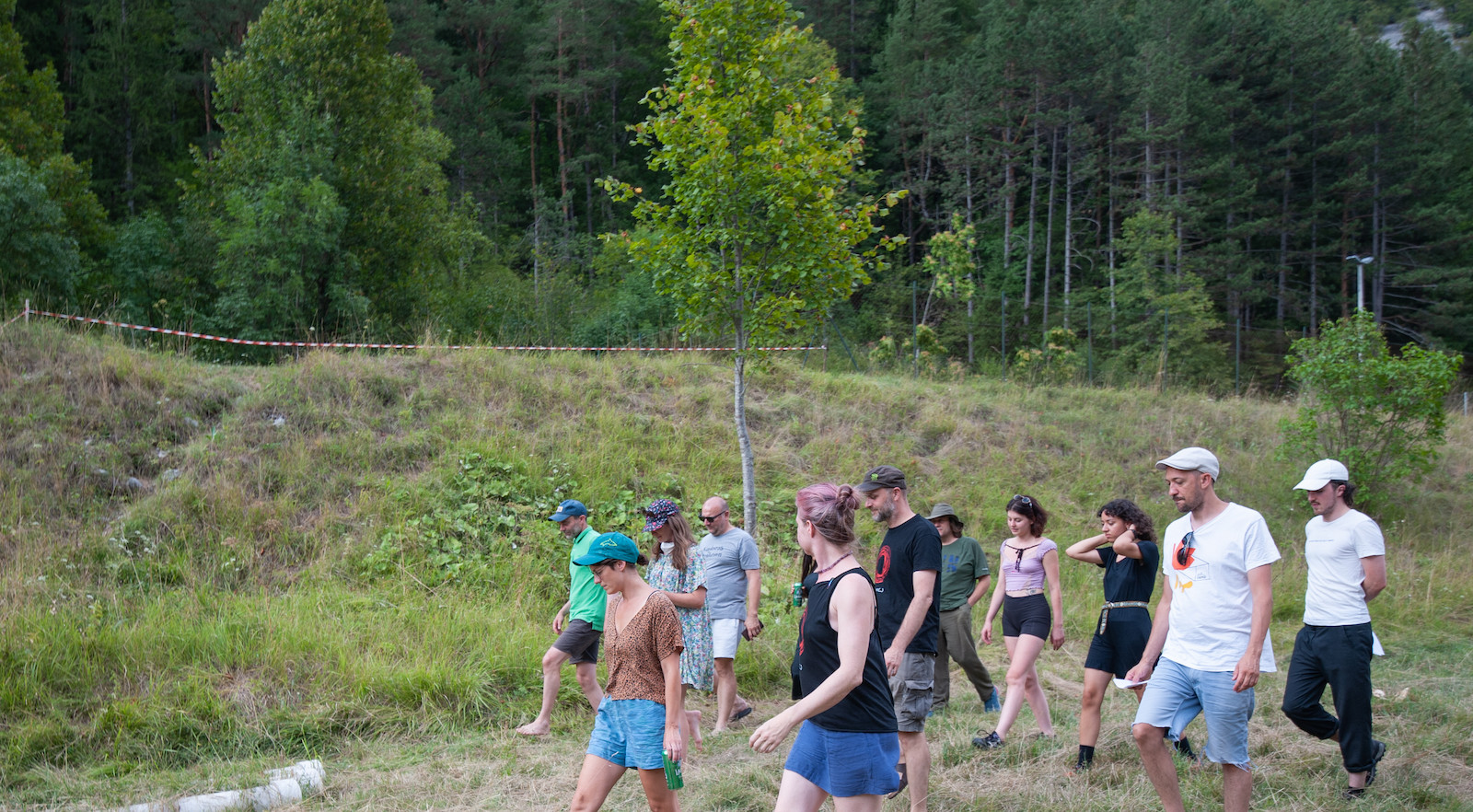
Shortly afterward, Theun invited the participants to a unique mix of exploring the surroundings of PIFcamp and a walk through the history of record-keeping. During the workshop, the participants learned how people have stored memories and knowledge, inscribed them in the landscape as we walked, and thus passed them on from one generation to the next.
Storing into the landscape. Photo by Simão Bessa
After dinner, all cam took time to reflect and talk about recent events/processes, and to plan for the Open Saturday. How did the work on the PIFprojects go? How many side-projects did the PIFers create? Are prototypes working? What will we present to the visitors of Open Saturday and how will we pack more than 30 different projects into one afternoon? Difficult questions, but not at all unsolvable for PIFers. The programme took shape smoothly and seamlessly, while we found solutions to technical, conceptual and nutritional mysteries and relaxed into the relaxed rhythm of Friday night.
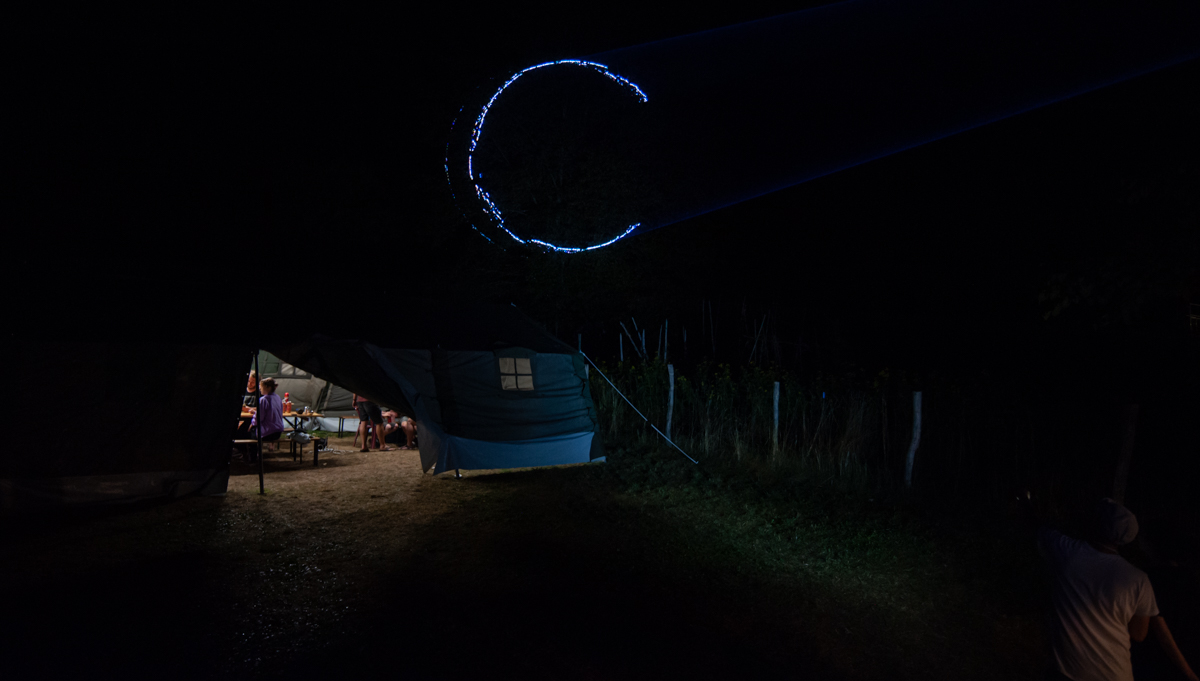
Tarot under the tent, lasers on the treetops. Photo by Simão Bessa
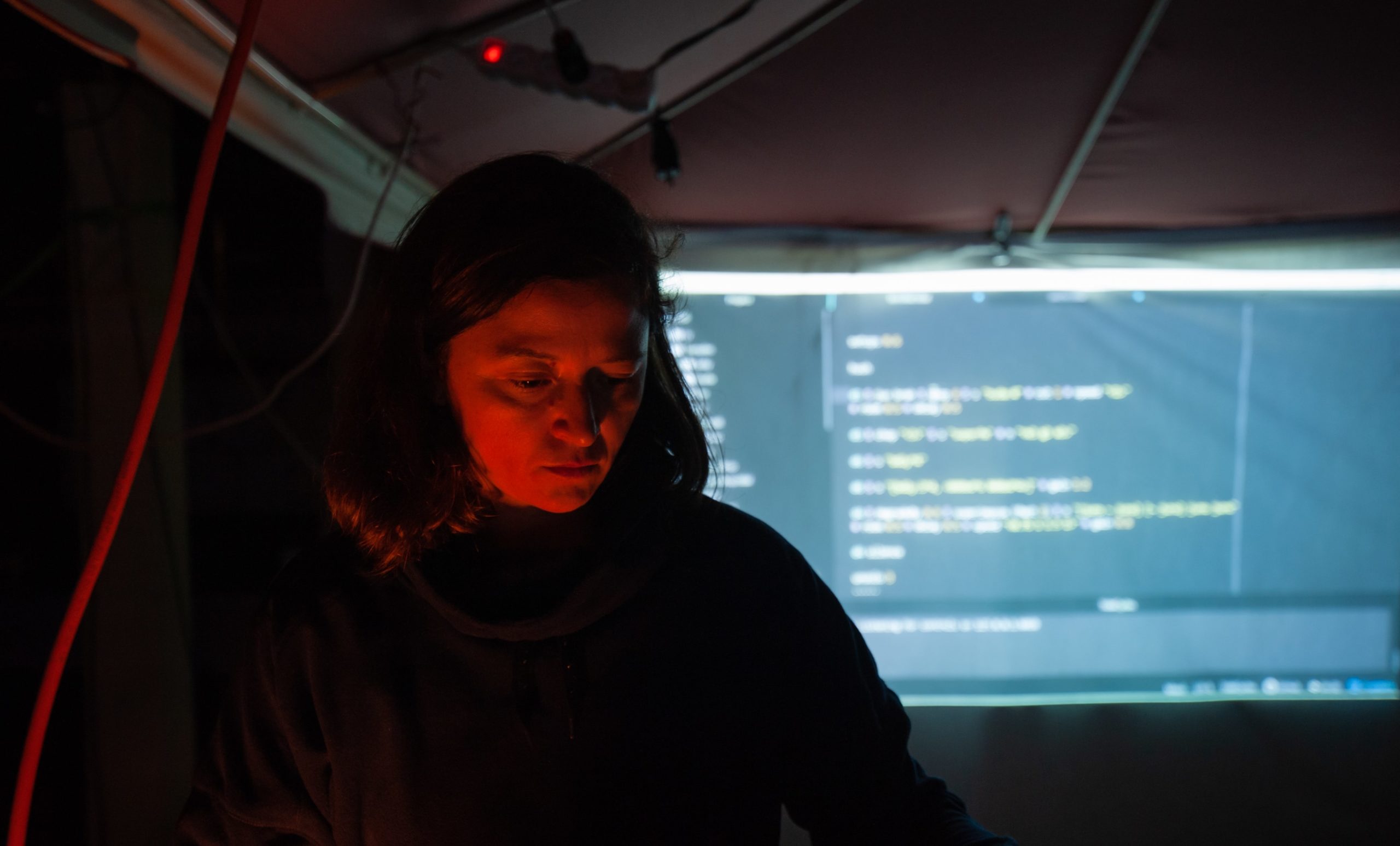
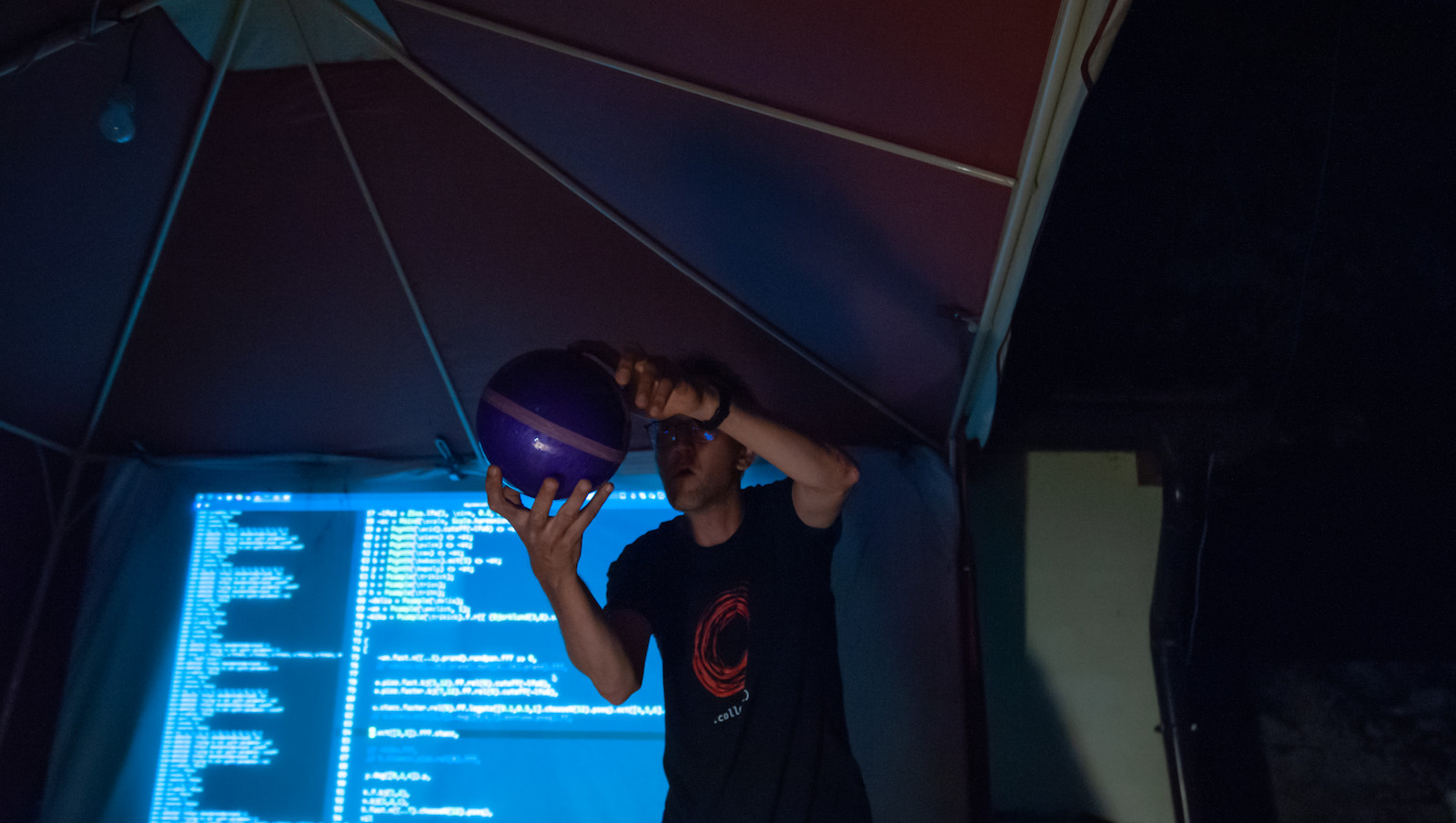
According to the PIF criteria, calm does not mean idleness, just a slightly lower volume of activity. Polona organized the traditional tarot game under the tent (finally!), and Bernhard and Katja – our PIFlog writer, learned about Bernhards laser and modular systems (she mentioned it was inspiring!) and experimented with visualizations projected on the tree. Meanwhile, a group of both new and die-hard live coding enthusiasts had gathered behind us, brought together by Julien. This time it was the turn of the Foxdot environment in combination with Troop, a tool that allows the connection of multiple coders and thus one of the most important PIFthings, the jam. The PIFcamp started to empty soon after, and the participants had to recharge their batteries before Saturday’s event. Good night!
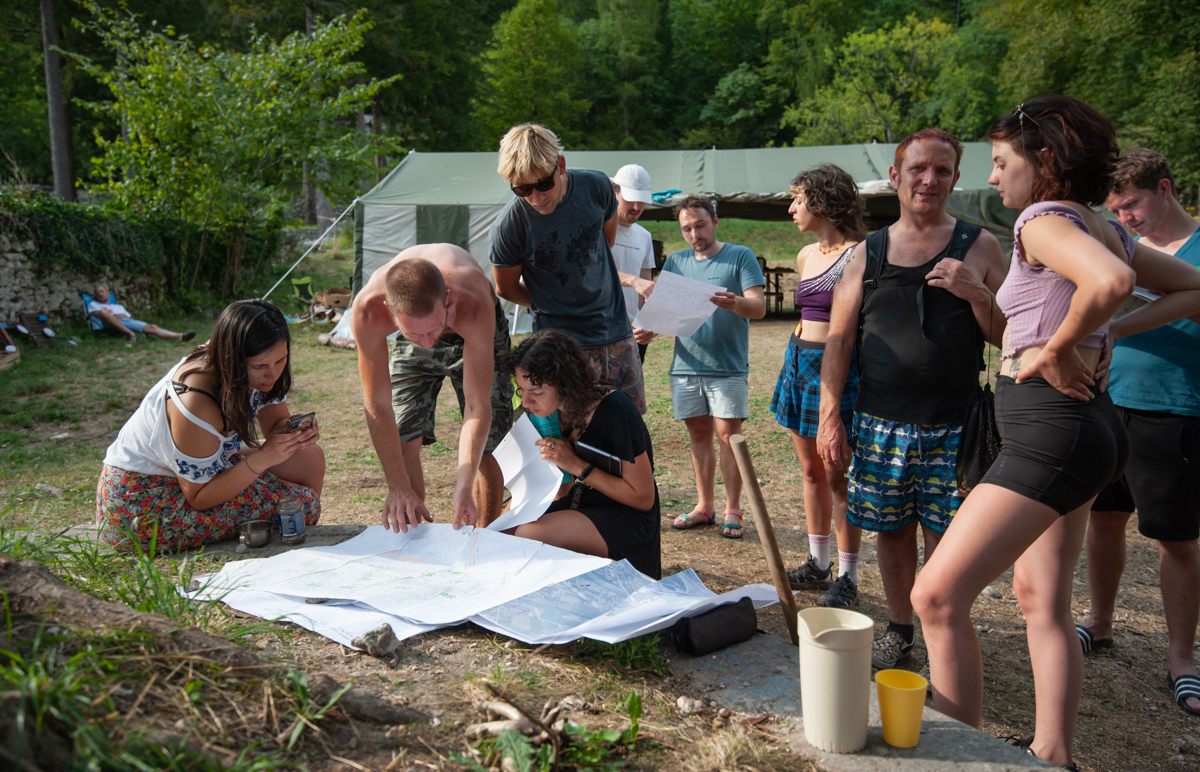
Thursday started early for some: before 6am (5:45am!), the bravest participants gathered for coffee and tea and decided to go on a long hike into the unknown with chef Klemn. They studied the map one last time and started the hike. A good hour later, more traditionally oriented PIFcampers went on a shorter hike to the Krn Lakes. Its is becoming almost an annual activity.
The PIFlog team is not large, but it has reliable sources and reports from several places at once. Photo by Simão Bessa
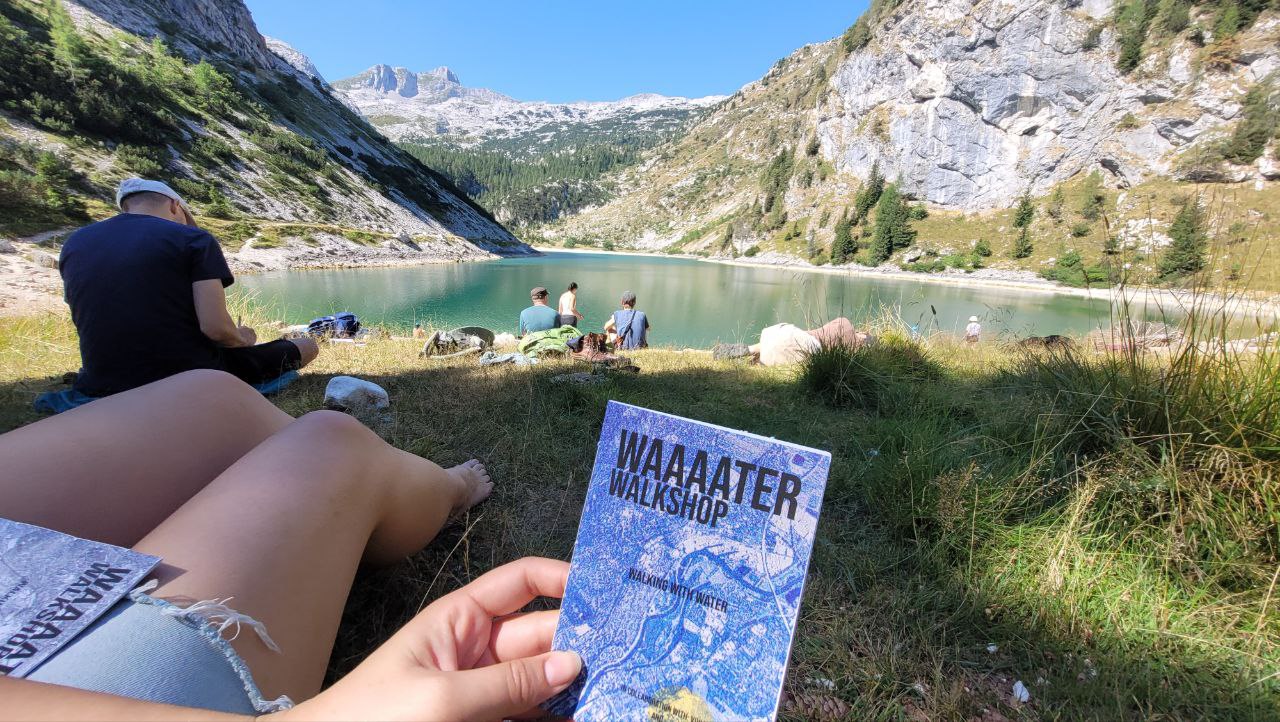
The participants are masters of multitasking, so they also held a Waaaater Walkshop during the traditional walk. Vivian‘s project was to allow the participants to slow down in the otherwise fast-moving atmosphere of PIFcamp. “The Walkshop allows you to explore, understand, feel and connect with your environment through walking,” she writes at the beginning of the booklet she created at PIFcamp. “In the notebook, I will ask you questions and invite you to draw, but remember that this is just a guide to help you discover and feel.”
Vivian walkshop notebook at Krn Lake. Photo by Vivian Hernandez Ramirez
Community archiving is an important part of Viviana’s walking workshop – each participant receives a notebook in which they write/draw their feelings and reflections. From the archive, we pulled out one of the twelve booklets that said “Becca”. As PIFlog writer always checks with the source, we asked Becca about her experience. “We opened the notebook by the beautiful lake and looked into the water, at the shape of the waves as they emerged on the surface. Vivian was also interested in how we could hear the water – we were on a lake that is otherwise calm. The only sounds were occasionally made by swimmers jumping into the lake, but it was a very calming experience.” Leafing through the booklet co-authored by Vivian and Becca was also a calming experience.
From the afternoon onwards, the fusion of synths and live coding came to the fore. Photo by Simão Bessa
By lunchtime (jota!), the hikers had already arrived at the base and were slowly blending in with the rest of the participants. Meanwhile, a few curious people had already gathered around Seamus on the lawn for a demonstration of the mini portable units, Datapods, sound synthesizers to which various sensors can be connected.
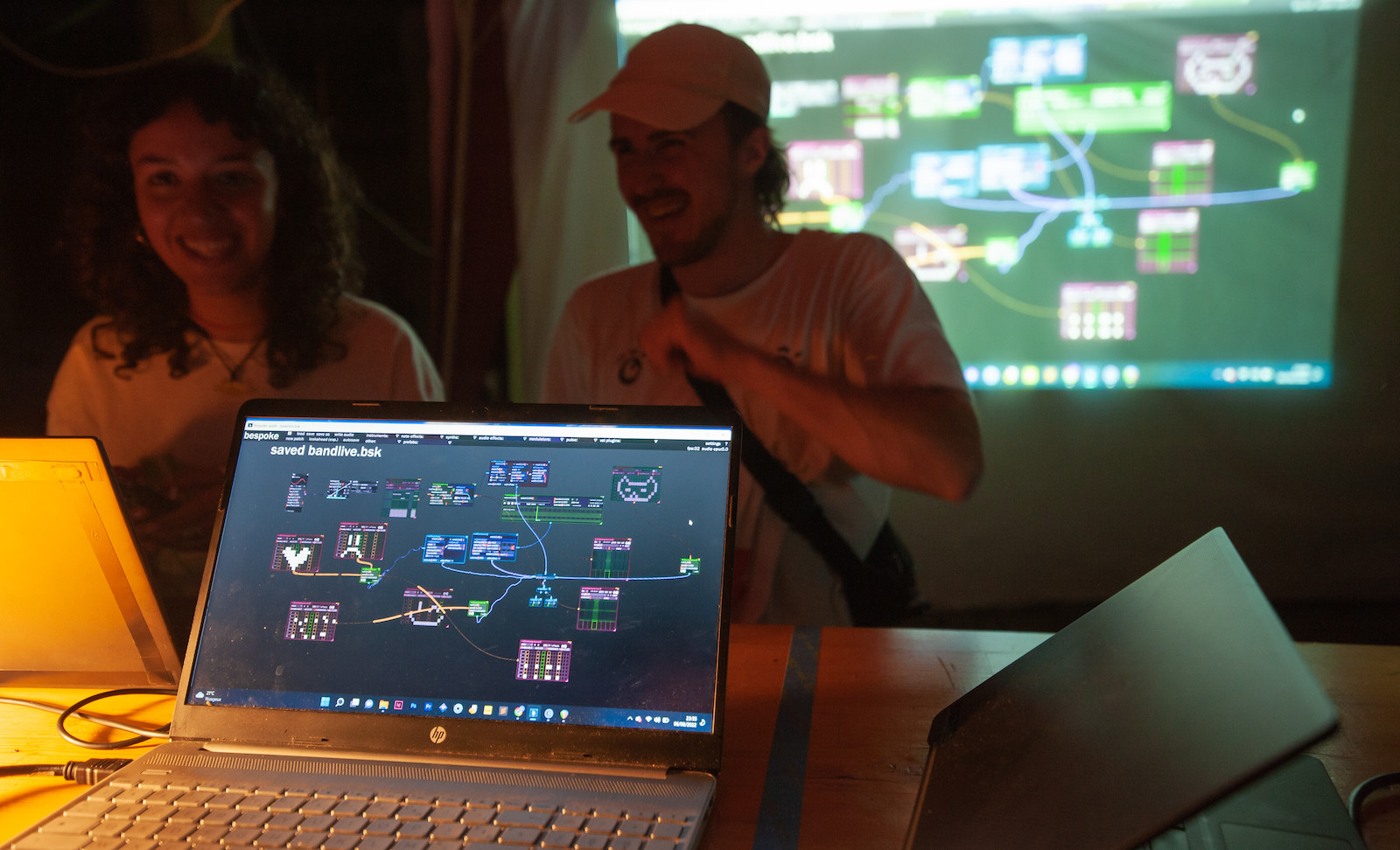
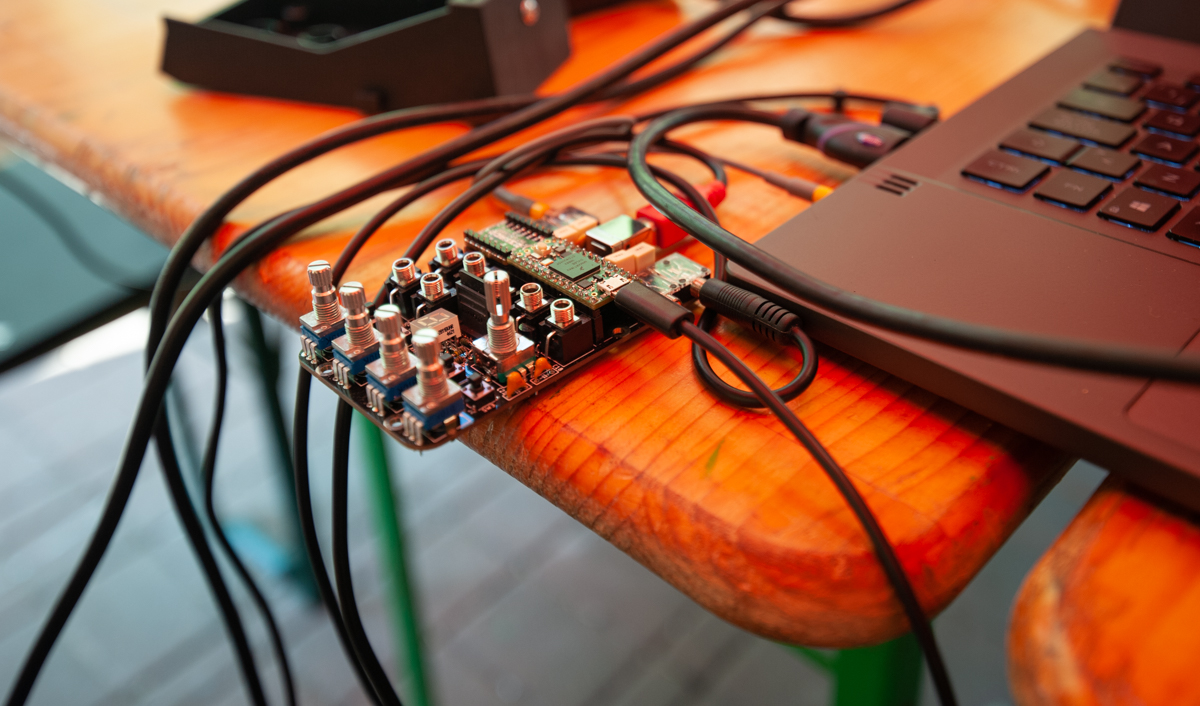
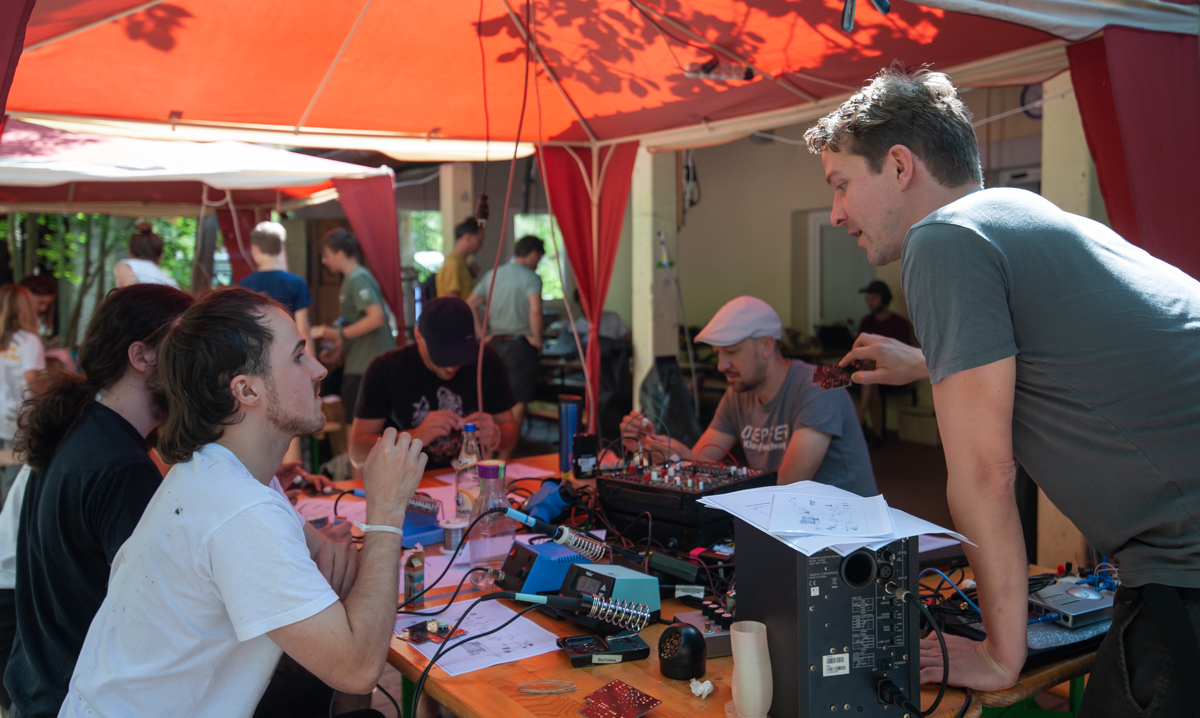
Soon after, ten participants gathered under the baldachín, turned on the soldering irons, and, under the watchful eye of Lina and Manu, started to assembling the Fantasía synth at the workshop. When the assembly was done Iván and Julia took over – guided the PIFers step by step through the process of programming the synth they had just built. The full-afternoon workshop was (verified!) also suitable for complete beginners, who thus built their first programmable synth to chase PIFnostalgia at home.
Assembling and coding Fantasía! Phot by Simão Bessa
At the same time, a silent sound began to echo through the PIFcamp and led us under a tree. Tilen set up a portable battery-powered sound system and gathered fellow synthesiser enthusiasts who provided a wonderful musical backdrop for lounging, active listening, and also small manual tasks (e.g. assembling extension cables or quietly typing of PIF blog).
Afternoon jam under a tree. Photo by Simão Bessa
At the same time, a journey through the history of field recording took place under the tent with Niklas, the guide you have already met in an earlier post. A lively debate developed among the interested audience, which was reinforced by listening to examples and sharing tips and hints.
Niklas lecture on combining field recording and live coding. Photo by Simão Bessa
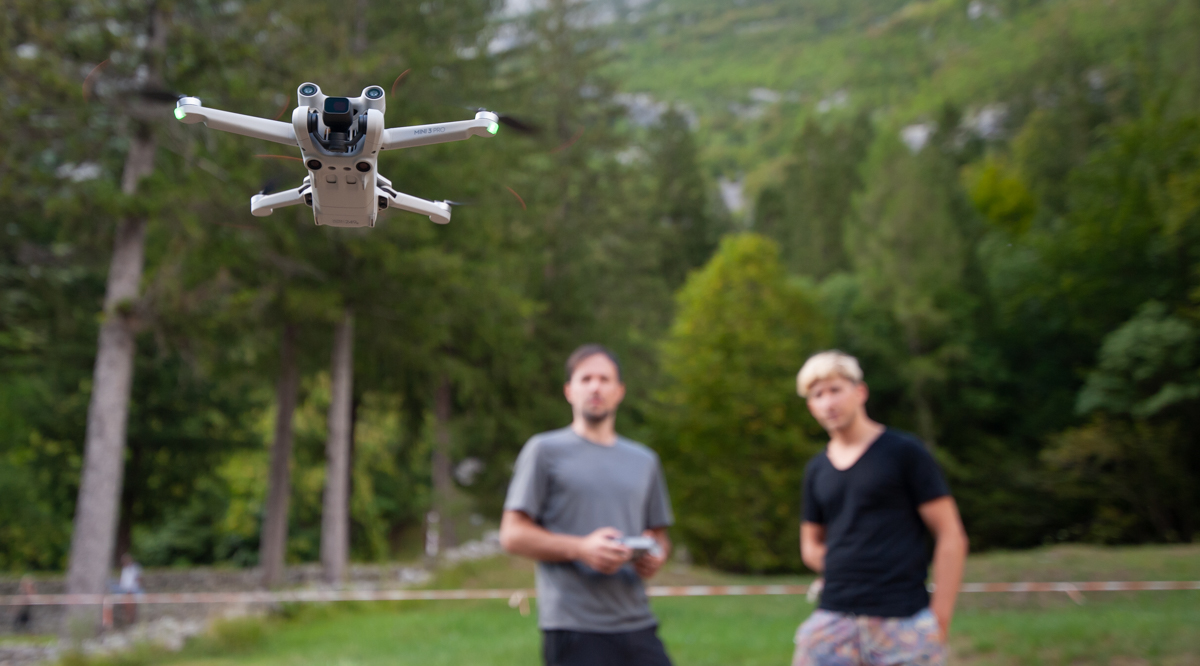
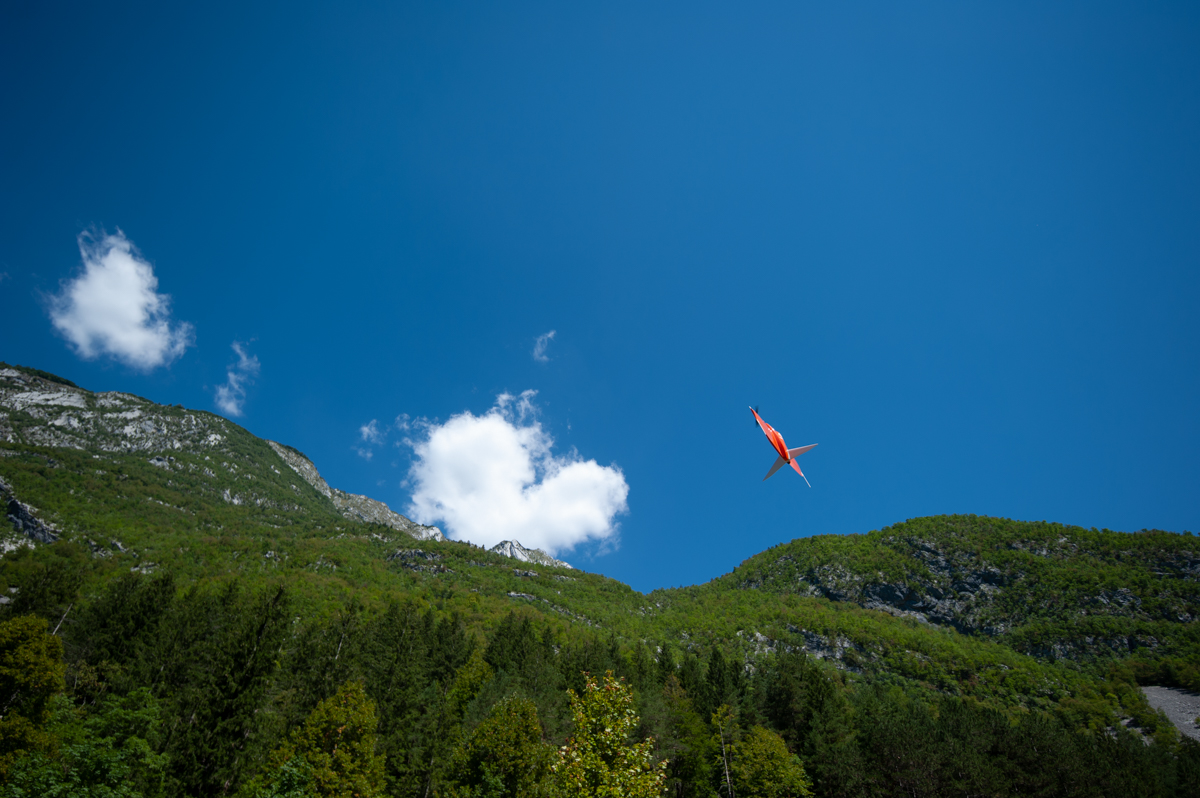
In the afternoon, the sky above us was still very bright as Marko used drones to map a part of the Soča River in the area close to PIFcamp. The Trenta mapping is part of his multi-year ISOLAB project, which you can find out more about in a short video documentary made by the PIFvideo team during our stay in Soča.
Drone take-off. Photo by Simão Bessa
Just before dinner, a few PIFampers gathered under a nearby tent for a workshop with Karl Yerkes to learn about the new dimensions of live music coding in C, in the CLAVM (C Language Audio Virtual Machine) environment. Karl told us about the workshop: ‘It’s about live coding in an ancient language that is still used all over the world, C, completely unnoticed. In the workshop I gradually show how to create increasingly sophisticated musical processes, starting with simple signals and mathematical operations. At the beginning, we learn the basics of digitally generated sound, digital signal processing, and basic mathematical functions. Then we try our hand at music composition with parameterization, parameter mapping strategies, pattern generation and effects. Layering functional abstractions, we begin to listen to music that deviates from the expectations associated with live coding in such a low-level language. Finally, we encode the music live in C.”
Lecture on CLAVM with Karl Yerkes. Photo by Simão Bessa
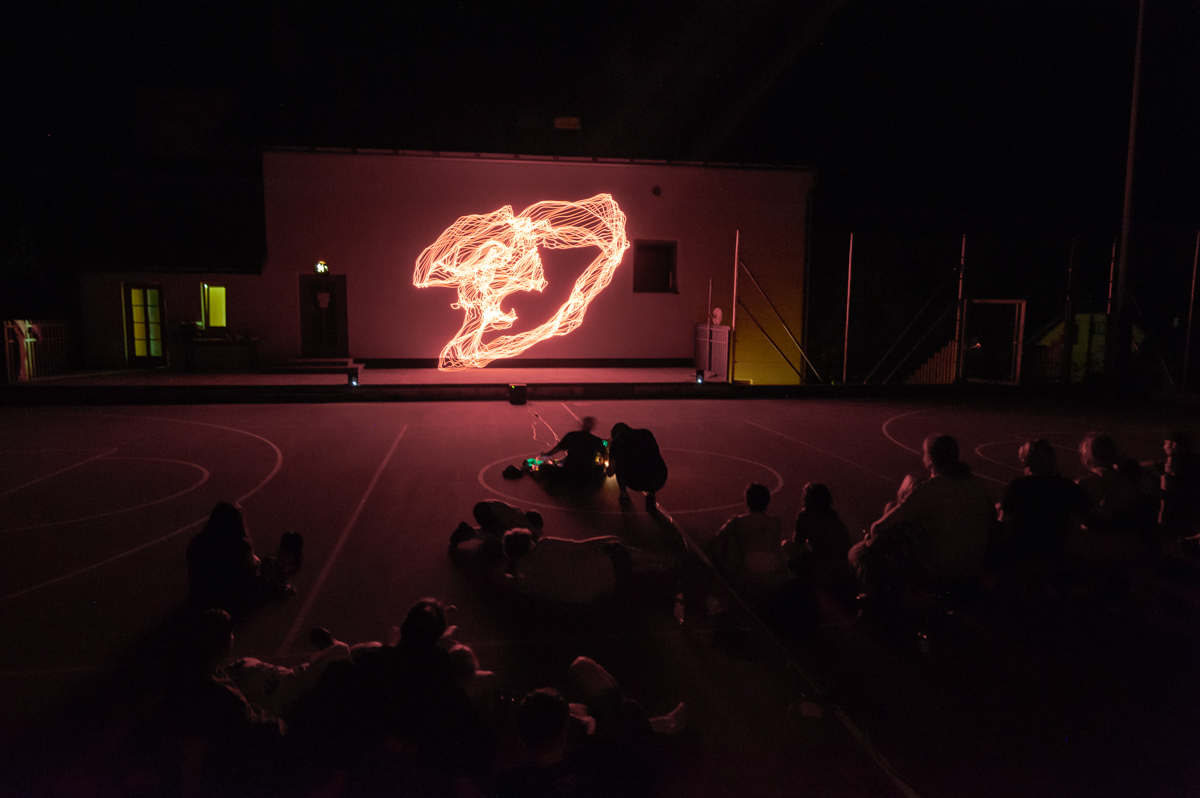
5th day after dinner, the PIFcamp odyssey of covid tests continued (all negative!) and one extraordinary event after another. First, Bernhard realized his long-awaited wish: he performed a laser show on the biggest wall in the PIFcamp area. All eyes of the participants (although the evaluation is rather subjective) were focused on the wall of epic proportions (at least for the village of Soča) next to the basketball court and enjoyed a 30-minute hypnotic AV performance.
Laser performance by Bernhar Rasinger. Photo by Simão Bessa
Blaž, the dome man, also had an adventure of sorts, on Thursday he finally got the chance (weather factor + human forgetfulness factor), to set up the speakers in a spherical sound system and invite passers-by (on the way to the basketball court-terrace route) to listen in. Unfortunately, this was the longest-lasting session in the Ambisonic Dome, as raindrops visited PIFcamp again in the following days.
Dome. Photo by Simão Bessa
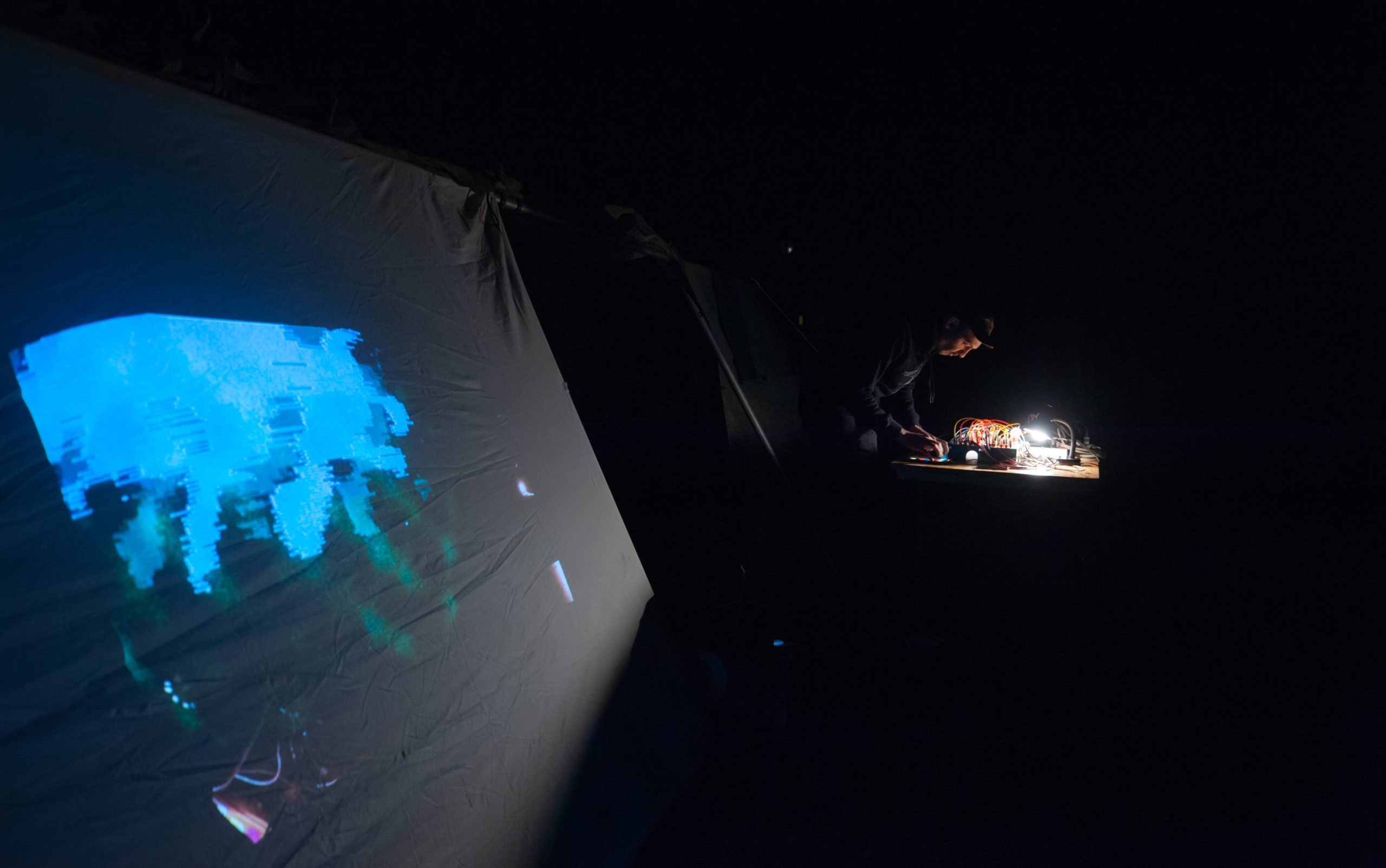
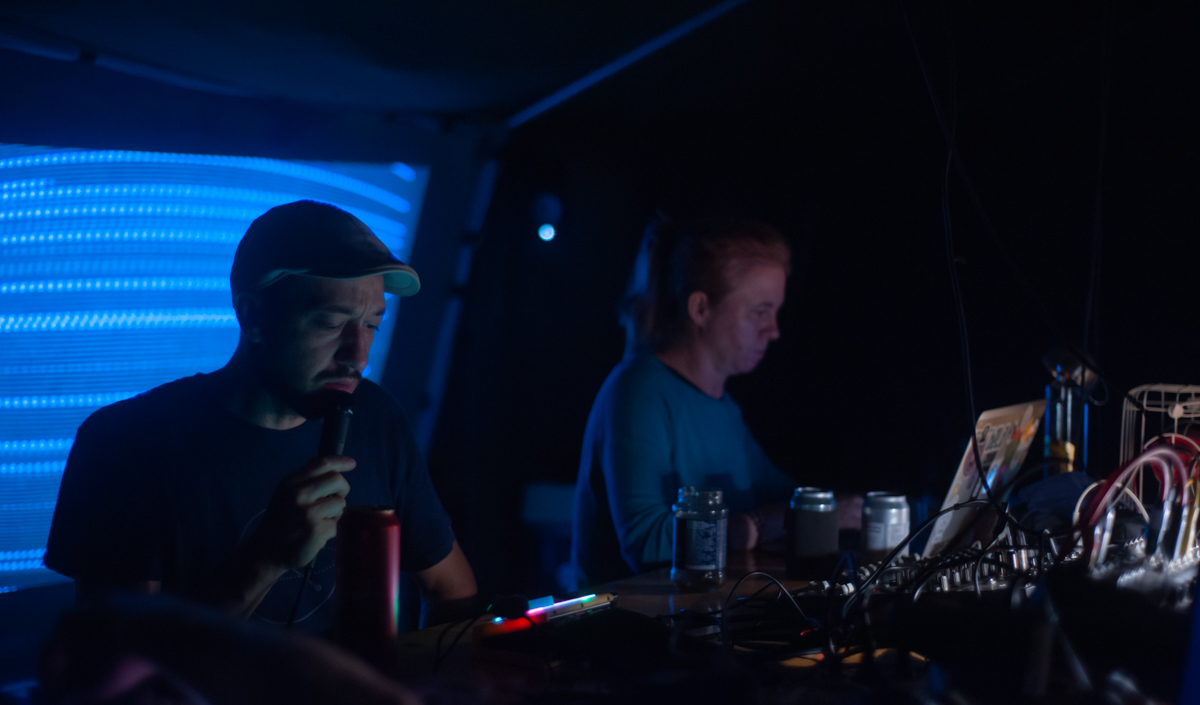
The tireless PIFcampers organised themselves and set up an AV jam under the tent just a few minutes after Bernhard’s performance. Aljoša accompanied the musicians on synths and in various live coding environments with visuals. On a rather massive system consisting of, among other things, an oscilloscope, an old video camera, and a video mixer (which Luka pulled out of a box labeled “obsolete video …”), he created a great visual focus for the energetic music from under the fingers of the coordinated performers. The atmosphere in the tent was so good that your favorite media team (photographer Simão and note-taker Katja) decided to move their office to the center of the action. The party was brought to an early end (at 1:00) by the law and order authorities.
Tent jam session Photo by Smão Bessa
The party has therefore moved under the covered terrace. The participants did not need to be told twice, the new venue was ready within one beer. Best not to waste too many words on the epic proportions, two will be sufficient: breakfast rave. Read on in the next few days to find out how the participants then took the obligatory hike and started preparing for the Open Saturday. After all this, we can’t conclude with a statement from the camp leader, Rea, who was asked how she was feeling on Friday afternoon: “I’m OK. Yesterday was such a calm day.” <3
Alicia Champlin provided a meditative introduction to Wednesday, inviting the participants to a cymbal sound bath. According to Thomas, who was briefly interviewed before lunch about his experience of the fourth day of PIFcamp, Alicia completely hypnotized the group. Afterwards, the visitors lay down in a meditative state, which our interviewer describes as a wonderful, long echo.
Another meditative PIFcamp practice, knitting. Photo by Simão Bessa
After the camp had settled down, the 10 active participants gathered for Ludwig’s workshop on how to make preamplifiers from old vacuum tubes originally designed for use in car radios. Thomas particularly liked the pace of the workshop, with participants soldering in harmony, moving between the stages of fabrication together, and even running into a problem together at the end. But of course, in the end, they also worked together and solve it!
Car Valves workshop led by Ludwig Klöckner. Photo by Simão Bessa
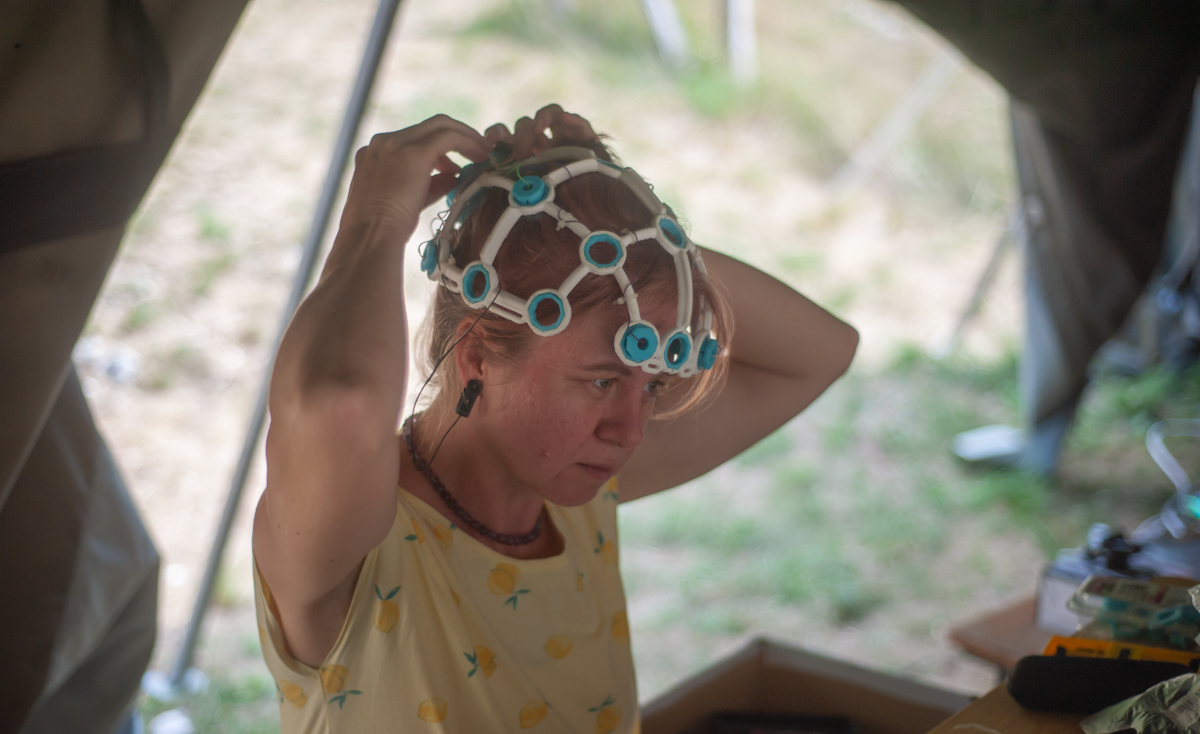
And than we moved back under the tent, where Alicia presented her brain rhythm synthesiser. She first demonstrated the sensor and the user interface that visualizes the frequencies of the brain rhythms and then presented the sonification software for the different classes of waves. As the headband sensor is entirely based on open source solutions and she wrote the program in MaxMSP, she set herself the goal of writing the program in the Pure Data environment at PIFcamp. If she succeeds, we will be able to hear the result on the eight-channel PA system in Blaž’s ambisonic dome! Hopefully soon!
OpenBCI EEG sensor. Photo by Simão Bessa
After lunch, August set up a collaborative radio station under the roof. He presented Mezcal, a browser-based tool he developed to diversify broadcasting and sound art practices, to provide alternative modes of communication for social movements and to create a new kind of technology for journalistic reporting. Roger also attended the workshop and was most impressed by August’s approach to collaborative broadcasting, which he sees as a communal sound composition. Participants also learned the principle in practice – they were divided into pairs and assigned an adjective that served as a cue for a sound improvisation. Roger and Thuen paired up to sound out the concept of health. The workshop was broadcast live by August on Mezcal and can still be heard there.
Collaborative radio workshop in Mezcal. Photo by Simão Bessa
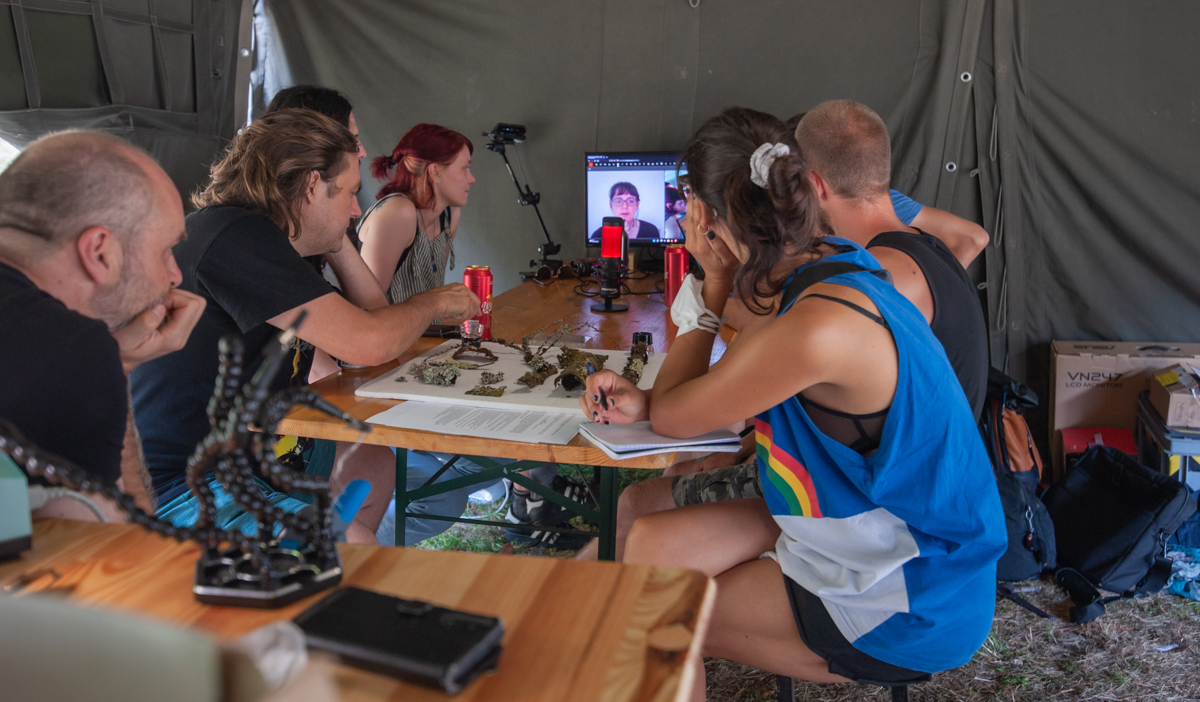
Meanwhile, artist Adriana Knouf joined us remotely via the web, from her residency in Copenhagen to present her artistic research project Foxes and Deeper Time. We talked to Eva and Nastja, two members of a team working on a prototype lichen observation system, about the event and the project itself. Adriana is a transgender artist who often focuses on space-related themes in her artwork. This offers her an escape from the sense of alienation that has been with her since childhood. Her current project links space travel with lichens, organisms that can survive in a vacuum.
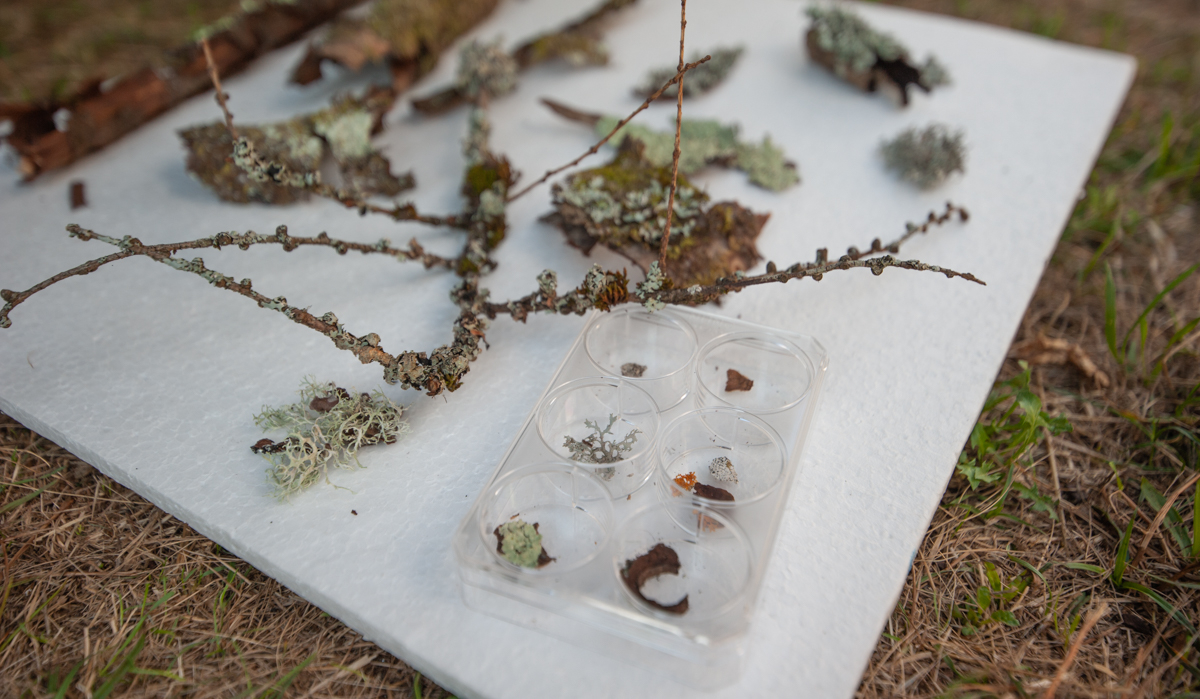
Lichen samples collected by the team along the Soča River. Photo by Simão Bessa
Adriana is developing a spacecraft for transporting lichens and is also researching the organisms, which have rarely been the subject of scientific research. The second major part of the project is the construction of a portable observatory, consisting of various sensors for organic functions and a camera. As Nastja points out, lichens grow extremely slowly – only one to two millimeters per year – so they need to build a robust device to observe and send data to the cloud. Eva also tells us that the team has carried out two expeditions to collect lichen samples along the Soča River for the lichen archive they are preparing as part of Adriana’s multi-year project.
Artist talk with Adriana Knouf. Photo by Simão Bessa
Before dinner, Marko Peljhan gave a comprehensive report on the recent large-scale fires in the Karst, which was listened to by a large group of PIFcampers. Marko’s company C-astral, which manufactures small unmanned aircraft systems, responded to a request from civil protection for help in mapping the fire. In just three days, they mapped some 4,500 hectares, and the images clearly show the aftermath of the devastating fire. Marko spiced up the otherwise serious subject with a number of anecdotes to entertain the gathered audience.
First-hand report. Photo by Simão Bessa
For the last report of the day, we returned to Thomas, who (admirable dedication! – after attending all the workshops that day) also visited Václav Peloušek‘s Auto-Tune workshop to round off the day. Václav’s excellent blend of instruction and personal experience was reinforced by numerous examples of compositions, and by presenting the history of this sometimes hated function, he showed that it can be used in so many ways that can actually add to the sound. Finally, participants tried their hand at Auto-Tune karaoke with a device that Václav launched in 2019 at PIFcamp. Fun for performers and the audience was guaranteed!
Auto-Tune workshop with Vaclav aka Toyota Vangelis. Photo by Simão Bessa
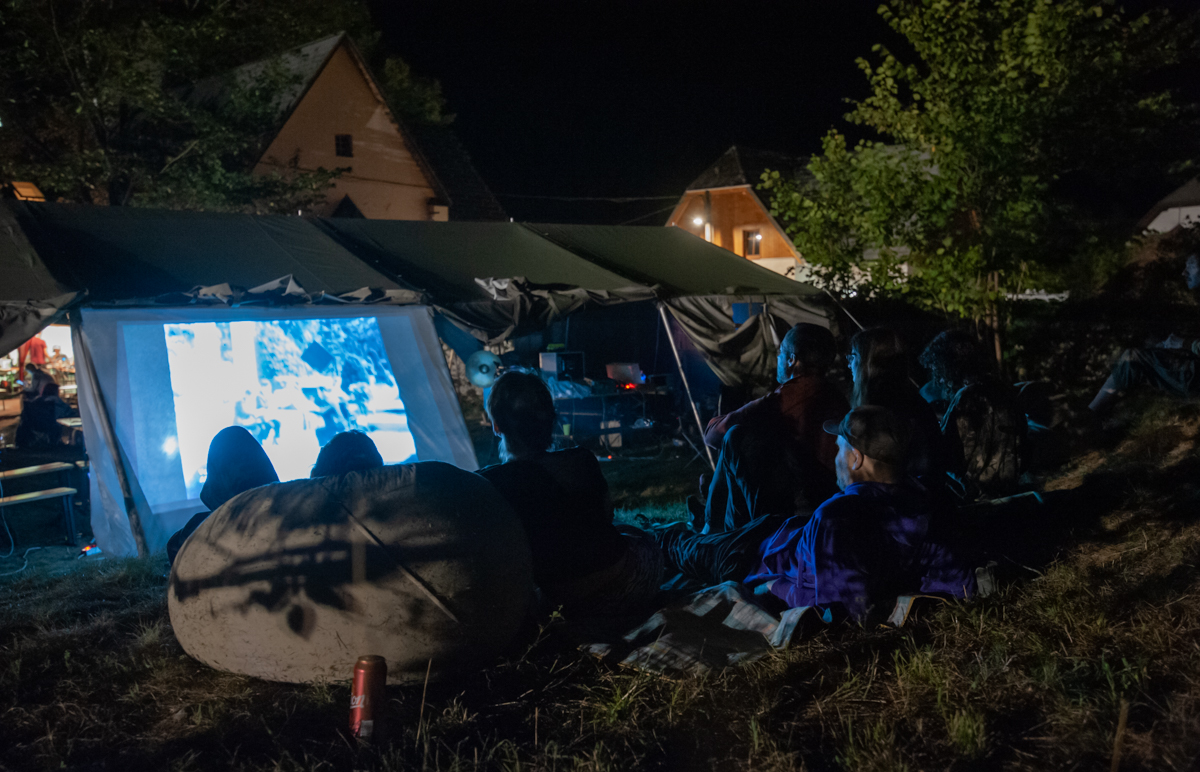
After the screening of the documentary Sisters with Transistors, most of the participants slowly went to rest, while a group of synth enthusiasts organised the opening jam session. Thursday’s event was even more varied, so you will read about it as soon as we finish processing all the impressions (short announcement: drones, lasers, synths, jam sessions, more jam sessions, breakfast rave). Don’t miss it!